Once a year, the small desert town of Tan-Tan becomes the meeting place of the Sahara. Families arrive with camels and tents, horsemen prepare their rifles and embroidered saddles, poets rehearse verses in Hassaniya, and a plain on the edge of town fills with hundreds of khaimas, the great nomad tents of the south. This is the Moussem of Tan-Tan, one of the most important living traditions in Morocco and one of the least known outside it.
This guide explains what the Moussem is, when the next edition takes place, what you will see, and how to visit Tan-Tan in a way that is comfortable, respectful and worth the long road south.
What is the Moussem of Tan-Tan?
In Morocco, a moussem is a seasonal gathering, often linked to a saint, a harvest or a place where people have always met. Tan-Tan's Moussem brings together the tribes of the south and the Sahara—Sahrawi, Tekna and many others—whose way of life was shaped by moving with herds across huge distances. For generations, meetings like this were where marriages were arranged, disputes settled, camels traded, news exchanged and poetry performed.
The modern Moussem was revived in 2004 after a long pause, and a year later UNESCO proclaimed it a Masterpiece of the Oral and Intangible Heritage of Humanity. In 2008 it was inscribed on the Representative List of the Intangible Cultural Heritage of Humanity. UNESCO's recognition is not for a building or a landscape, but for knowledge that lives in people: songs, poems, crafts, horsemanship, camel breeding and the social customs of nomadic life.
What you will see
The tent village
The heart of the Moussem is its encampment. Large khaimas, traditionally woven from camel and goat hair, are set up by tribes and families and furnished with carpets, cushions and tea trays. Inside, the rhythm is slow: three glasses of mint tea, conversation, music in the evening. Visitors are often invited in; accepting a glass of tea is the simplest way to understand the spirit of the event.
Camel races and camel culture
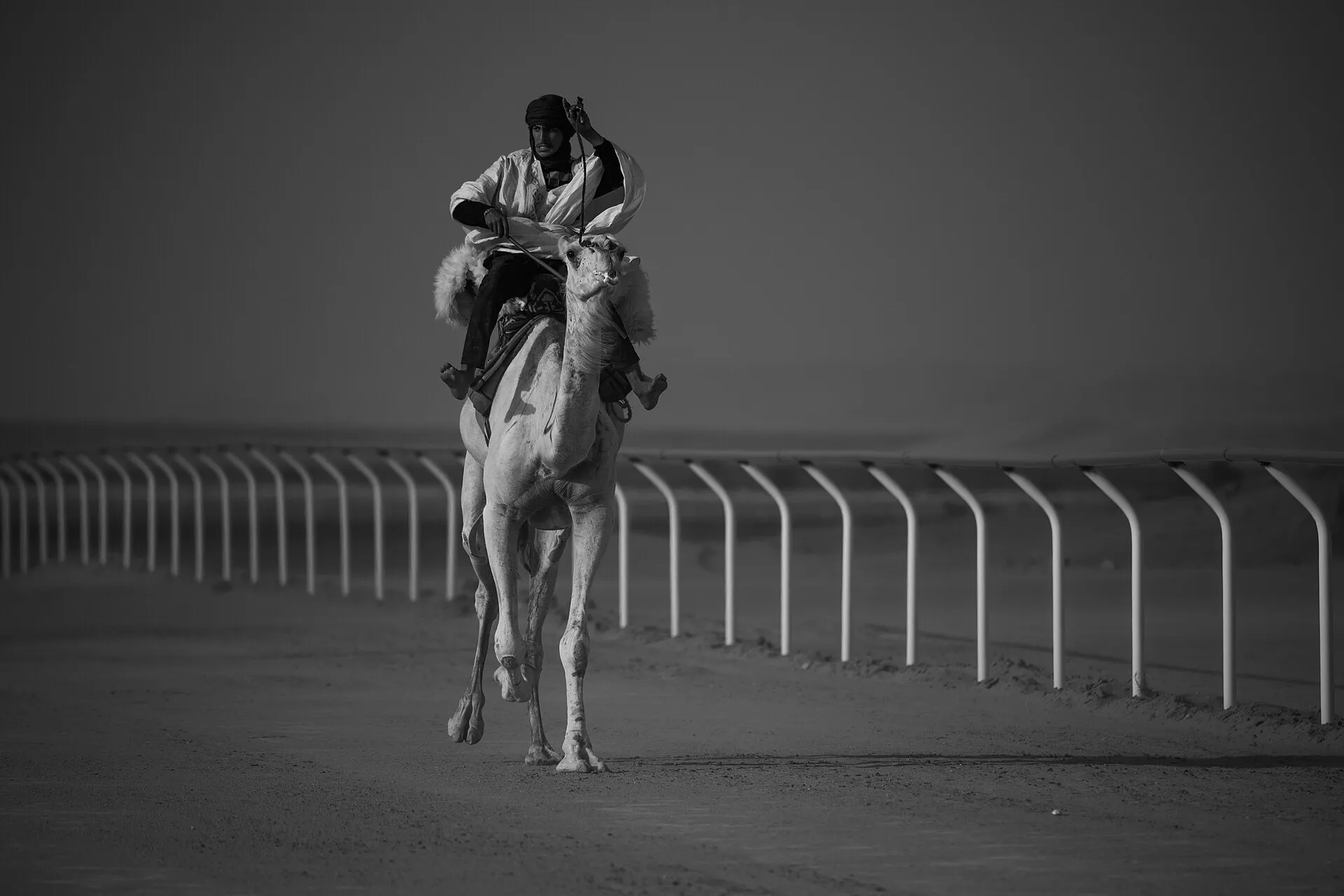
Camels are the reason the Moussem exists. Races on the dedicated track draw big crowds, and there are displays of camel breeds and competitions for the finest animals. Around the edges, herders discuss bloodlines and prices exactly as they have for centuries.
Tbourida: horsemen and gunpowder
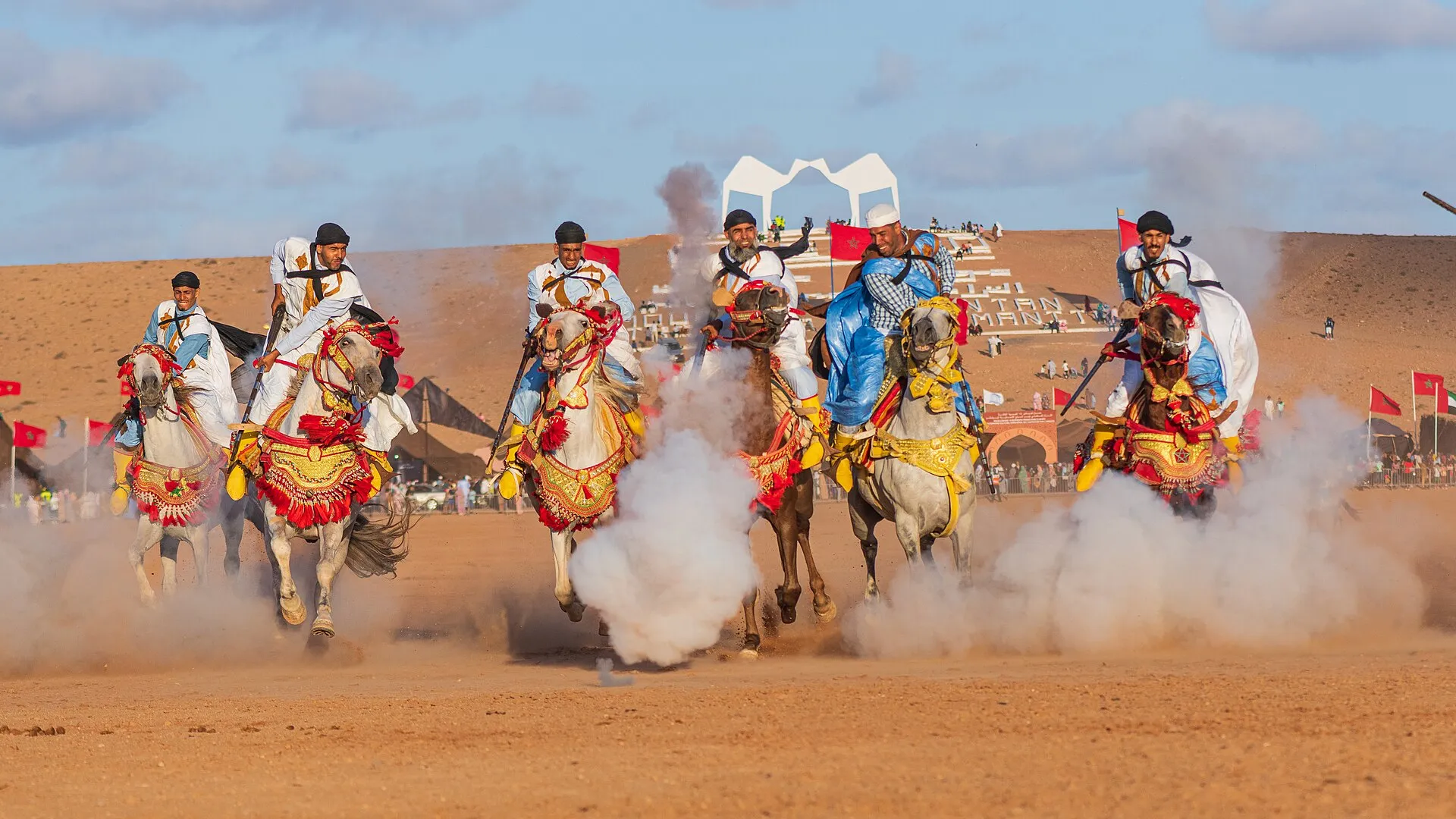
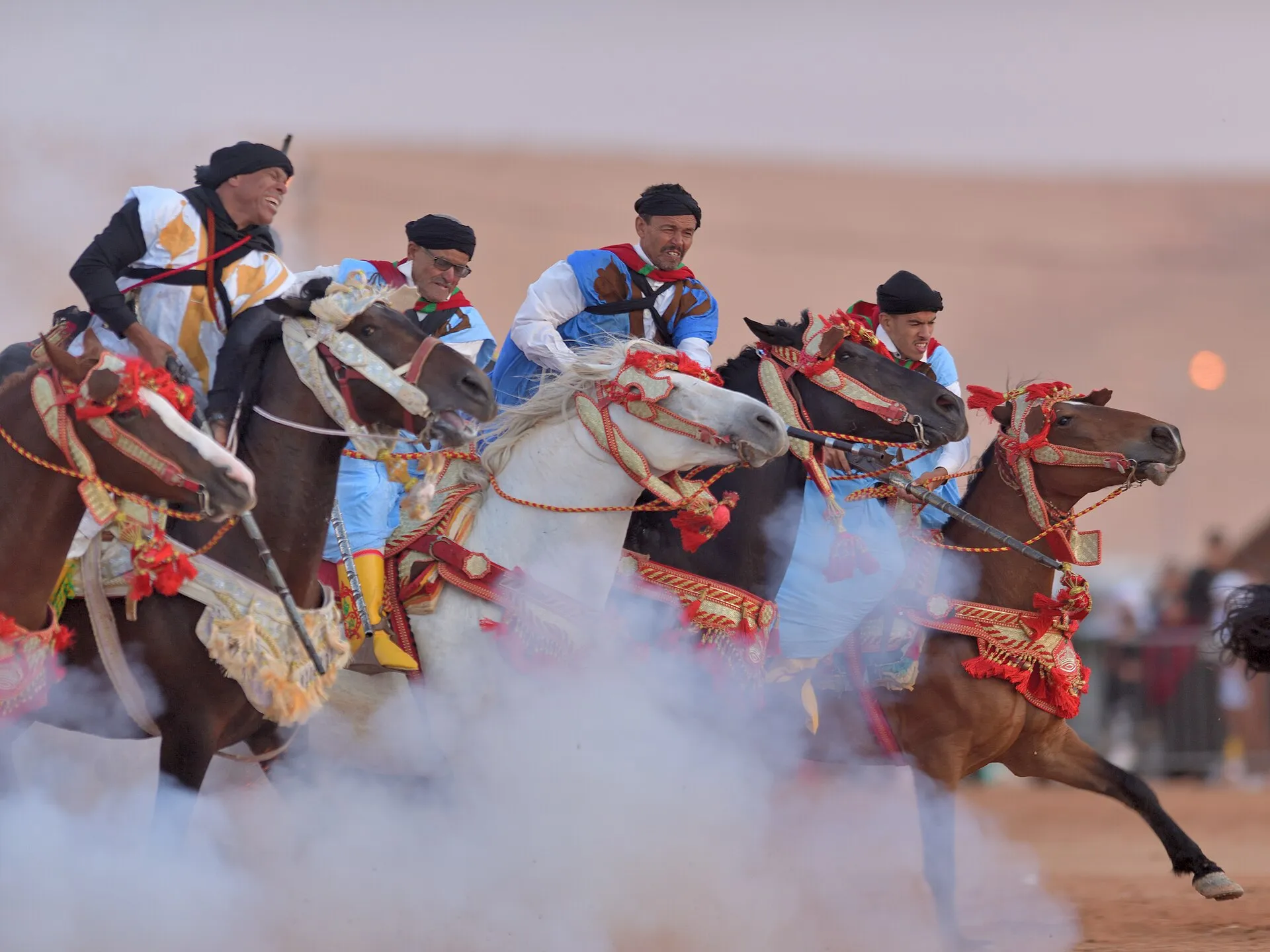
Tbourida, sometimes called fantasia, is a display of horsemanship in which a line of riders, called a sorba, gallops forward and fires its old muskets in a single volley. The goal is perfect unison: one shot, one cloud of smoke. It is loud, fast and deeply proud, and the horses' embroidered saddles and bridles are works of art in themselves. Tbourida was itself inscribed by UNESCO in 2021.
Poetry, music and dance
Hassani poetry is one of the great oral traditions of the Sahara, and the Moussem hosts recitals and competitions. Evenings bring music with the tidinit lute and drums, and dances such as the guedra, performed kneeling to a steady, hypnotic rhythm.
Crafts, dress and food
Stalls and tents show leatherwork, silver jewellery, woven textiles and the flowing daraa and melhfa of Saharan dress. Food follows the desert: camel meat, grilled lamb, dates, camel milk and endless tea.
When to go
The Moussem has been held at different times of year, most recently in late spring or autumn, and its dates are fixed by the organisers each year. For 2026, the 19th edition is planned for 30 October to 3 November, moved to coincide with Morocco's national celebrations at the end of October. Late autumn is a comfortable season in the south: warm days, cooler evenings, and pleasant conditions on the Atlantic coast.
If your dates do not match the Moussem, Tan-Tan and the surrounding region are still worth visiting from October to April. For general seasons, see our guide to the best time to visit Morocco.
Getting to Tan-Tan
Tan-Tan is far from the classic Marrakech–Sahara circuit, which is part of its charm. Realistic driving times:
| From | Approx. drive | Notes |
|---|---|---|
| Guelmim | 2 hours | The "gateway to the Sahara", with its weekly camel market. |
| Agadir | 4.5–5 hours | The most common starting point, with international flights. |
| Marrakech | 8–9 hours | Best split with a night in Agadir, Taroudant or the Anti-Atlas. |
Driving at night in the south is best avoided because of livestock and long unlit stretches. Our Morocco itinerary guide explains how to pace long drives.
Where to stay
Hotels in Tan-Tan are few and simple, and they fill quickly during the Moussem. Good options include guesthouses in El Ouatia (Tan-Tan Plage) on the coast, 25 kilometres away, or staying in Guelmim or the oases around it and driving in. Plan accommodation as early as possible once dates are confirmed.
Beyond the Moussem: the region around Tan-Tan
- Guelmim and the oases of Oued Noun — camel market, palm groves and hot springs at Abaynou.
- The Atlantic coast — El Ouatia, the wild beaches around Plage Blanche, and the cliffs north towards Sidi Ifni and Mirleft, part of our southern coastal journey.
- Khnifiss National Park — a lagoon among dunes south of Tan-Tan, with flamingos and waders; see our bird watching guide.
- The Anti-Atlas — Tafraoute's granite landscapes and almond valleys, a beautiful way to arrive or leave.
Visiting respectfully
- Remember whose gathering it is. The Moussem is a family and tribal reunion before it is a show.
- Ask before photographing people, especially women and children in the tent village.
- Dress modestly and accept tea when it is offered; it is a gesture of welcome.
- Keep clear of the tbourida and race tracks and follow stewards' directions.
- Buy crafts directly from the makers where you can.