The best thing you buy in Morocco might be a rug you live with for years, a bowl that brings colour to your table, or a pair of slippers you wear until the soles soften. It need not be expensive. What matters is knowing what you are looking at, enjoying the conversation behind it, and leaving with something you chose—not something you were persuaded to carry.
If you are wondering what to buy in Morocco, start with craftsmanship rather than a shopping list. Marrakech and Fes offer an extraordinary range of rugs, leather, ceramics, metalwork and textiles, but a beautiful display does not tell you where something was made or how well it will last. This guide is about buying thoughtfully: which Moroccan souvenirs deserve a closer look, what to ask, when to bargain, and what to arrange before taking a larger piece home.
What to buy in Morocco: pieces worth considering
1. Moroccan rugs and woven textiles
A handwoven rug can be the most meaningful—and the most complicated—purchase of a journey. Look beyond the first impression of colour and pattern. A thick pile rug, a flatwoven kilim and a lighter textile serve different purposes; think about your room, the surface underneath, how much foot traffic it receives and whether you can maintain it.
You may hear names such as Beni Ourain, Azilal or Boucherouite. They can help begin a conversation about regional traditions or materials, but a label alone does not establish where a particular rug was made. Contemporary designs may draw on several traditions, and pieces sold in a Marrakech or Fes shop may have travelled from another region.
- Ask: What are the pile and foundation made from? Where was it woven, and what supports that description?
- Look: Turn it over, inspect edges and fringe, and check for repairs, holes, uneven wear or a backing that hides the weave.
- Clarify: Is it new, used or genuinely older? Has it been washed, repaired or treated? How should it be cleaned?
- Measure: Include fringe and allow for doors, furniture and the space where the rug will sit.
Small irregularities can be part of handwork, but they are not proof of authenticity. Nor is a very dense weave automatically the right choice for every kind of rug. If provenance or age is essential to the purchase, seek independent specialist advice rather than rely on a compelling story. Avoid letting a supposed one-day shipping offer rush a decision you will live with for years.
2. Ceramics, bowls and tagines
Ceramics are among Morocco's most satisfying gifts: a painted bowl, a serving platter or a small vase can be both useful and beautiful. Fes is especially associated with blue pottery, while Safi is another important pottery centre. Shops in either city—and in Marrakech—may offer a mixture of local work and pieces sourced elsewhere.
Inspect the rim and base for chips, cracks and a finish that suits the intended use. Hand-painted variation is different from damage. Ask who made the piece, where it was fired and whether the decoration is painted by hand. If a matching set matters, compare the individual pieces rather than assume they are identical.
Food safety deserves a separate question. Decorative pottery is not automatically safe for food contact. A painted tagine may be decorative rather than suitable for a hob or oven. Ask for credible information about food-contact safety and the precise cooking and care instructions; a verbal “of course” is not enough when these are unclear. If you cannot establish suitability, enjoy the object as decoration instead.
3. Leather bags, babouches and poufs
Fes's leather-working heritage makes it a natural place to explore bags, belts, slippers and poufs. Marrakech also has a wide selection, including contemporary designs. Seeing a tannery is interesting cultural context, but it does not prove that every product in the nearby shop was made there.
Examine the seams, lining, handles and closures. Open and close the zip, check stress points and try slippers on both feet. For a bag, think about how it feels with weight inside. Ask about the leather type, finish, colour transfer and care; avoid destructive “tests” with fire or water. Smell alone does not establish quality or the tanning method.
A pouf can be easier to carry empty, but confirm whether filling is included and how the cover opens. Write down the dimensions before buying one for a specific space. Practical construction matters more than an elaborate claim that everything is “traditional.”
4. Lanterns, brass and copperwork
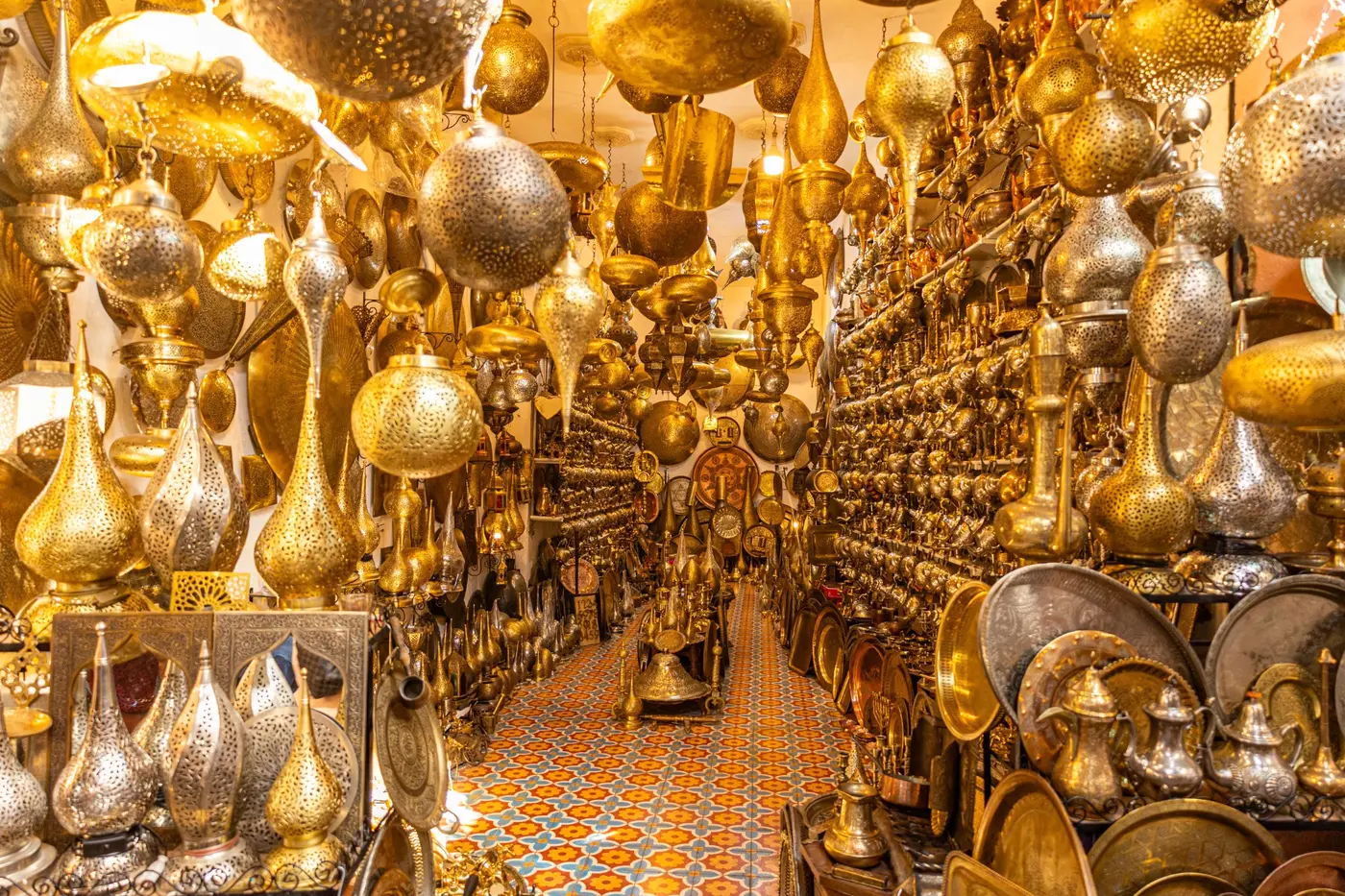
Pierced-metal lanterns and handworked trays can bring the atmosphere of a Moroccan interior home without copying an entire room. Look closely at the cuts, joins, stability and finish. Ask whether the piece is solid brass or copper, another metal, or plated; the colour alone will not tell you.
Lighting needs more planning than a decorative tray. Check dimensions and weight, and ask which fittings are supplied. Do not assume wiring is suitable for your country's voltage or safety requirements: have a qualified electrician assess it before installation. A small lantern may fit your luggage; a large hanging fixture needs a realistic packing and delivery plan.
5. Argan oil and Moroccan beauty products
Argan oil is closely connected to southwestern Morocco. UNESCO recognises the knowledge and practices surrounding argan, including a production tradition in which women play an important role. That cultural background is worth understanding—but it does not certify any particular bottle on a shelf.
Begin by distinguishing culinary oil from cosmetic oil. Read the ingredient list, confirm the intended use, and look for an identifiable producer, a sealed container and useful batch or expiry information. If you want pure argan oil, establish whether other oils, perfume or additives are present. A fragrance, colour or shop demonstration cannot reliably prove purity.
A cooperative visit can be worthwhile when the organisation explains its members, production and sales clearly. The word “cooperative” on a sign is not, by itself, independent verification of working conditions or certification. Buy a quantity you will use, follow storage guidance and do not accept medical promises as a reason to purchase. Black soap and other beauty products also deserve clear ingredients, especially if you have sensitive skin or allergies.
6. Spices, tea and edible gifts
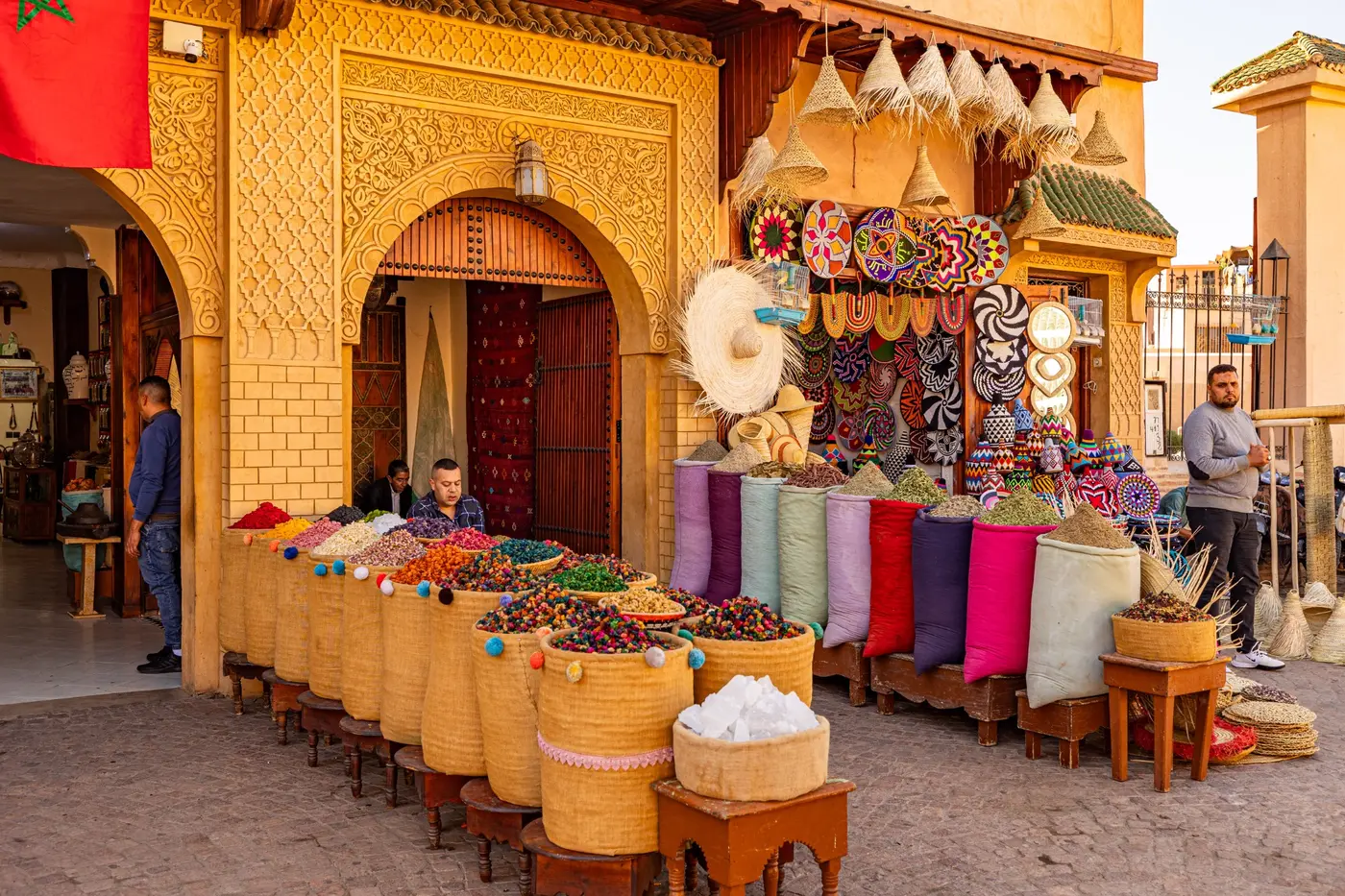
Spice stalls are a pleasure to browse. Cumin, ginger, paprika and a small quantity of a clearly described blend may be more useful than a large assortment you will never open. Ras el hanout is not one fixed recipe: ask what is in the seller's blend, especially if you have allergies or dietary restrictions.
For saffron, ask about origin, harvest and packaging rather than rely on dramatic demonstrations or a promise that every brightly coloured thread is genuine. Choose quantities suited to your cooking and an identifiable supplier. The same care applies to tea, herbs and preserved foods: ask about ingredients, storage and sealing.
Check the destination's import rules before paying. Commercial packaging does not make every food, seed, herb or animal-derived product admissible. Keep labels and receipts; declare food where your destination requires it. Buying a small edible souvenir locally to enjoy during the trip may be simpler than carrying it across a border.

7. Jewellery, scarves and embroidered clothing
A small piece of jewellery or a woven scarf is easy to enjoy long after a journey. With jewellery, distinguish the material from the style: “Amazigh-inspired” describes a design, not necessarily its age, origin or silver content. Ask about metal purity, stones, repairs and any hallmark, and obtain a written description for a significant purchase. A magnet test alone does not prove silver.
For kaftans, djellabas, scarves and embroidery, examine seams, hems, lining and closures. Ask which fibres are used and whether decoration is handworked or machine-made. Both can be attractive; the important thing is an honest description. Try garments on and confirm alterations, collection dates and what happens if the finished fit is wrong.
8. Baskets, woodwork and smaller souvenirs
Woven baskets, carved boxes and cushion covers offer an alternative to fragile or very heavy purchases. Check handles and edges for strength, and make sure a lid or hinge works comfortably. Ask about wood species and whether a piece is solid wood, veneer or another material; aromatic scent is not proof of age or origin.
Natural materials may raise agricultural or protected-species questions at your destination. Avoid objects made from unidentified exotic woods, wildlife parts or materials a seller cannot explain. For small gifts, a well-made practical object with a clear origin is usually a better choice than a supposed antique with no documentation.
Marrakech, Fes or Essaouira: where should you shop?
Marrakech is a good all-round choice when you want to compare rugs, leather, lanterns, baskets and contemporary Moroccan design. The medina and studios beyond it offer different experiences. Leave time for both if interiors or fashion are a priority; the busiest market lane is not necessarily the best place for your particular purchase.
Fes rewards curiosity about making as well as buying. Ceramics, embroidery, leather, woodwork and the metalworking area around Seffarine can connect a finished object with a wider craft story. Its intricate medina takes patience: concentrate on a few categories rather than trying to find everything in one afternoon.
Essaouira can suit a slower day of browsing woodwork, art, jewellery and small independent shops. It is particularly associated with thuya woodwork; ask about species, sourcing and any export or import restrictions before buying natural materials. It is not automatically cheaper or more authentic than the imperial cities.
Choose according to your itinerary and interests, not a promise that one city has all the bargains. Objects travel between cities, and the place of sale is not always the place of production. Our Morocco itinerary guide can help you leave enough time for the cities you actually want to explore.
How to bargain in Morocco without turning it into a contest
In many souk shops, discussion is part of agreeing a price. In others—particularly some boutiques, cooperatives and stores with marked prices—the price may be fixed. Ask first, and respect the answer. Bargaining is not a universal rule for every purchase or every service.
- Understand the object. Confirm material, size and condition before negotiating; two similar-looking pieces may not be equivalent.
- Compare calmly. Visit more than one seller when appropriate and compare the total cost, not just an opening figure.
- Set your own limit. Decide what you would be comfortable paying without relying on a universal percentage discount.
- Make a considered offer. Keep the conversation courteous and avoid negotiating at length for something you do not want.
- Confirm the agreement. Clarify the currency, exact item and any extras before payment. If you agree to buy, honour that agreement.
You may walk away before committing. A simple “No, thank you” is sufficient. Tea, a demonstration or time spent showing rugs does not create an obligation. If urgency, insults or pressure replace a comfortable conversation, leave. The aim is a purchase that both sides can accept—not a story about defeating the seller.
Buying well: authenticity, pressure and useful questions
“Handmade,” “vintage,” “pure,” “local” and “cooperative” are starting points for questions, not conclusions. Ask who made the object, which steps were done by hand, what the material is and what documentation supports a significant claim. Machine-made or contemporary work is not inherently bad; presenting it as something else is the problem.
For a substantial purchase, request a receipt with the seller's contact details, date, item description, agreed price and any delivery arrangement. Photograph the exact piece and, where relevant, its condition, labels and measurements. Clarify payment fees and the currency charged; use a payment method you understand and keep the records.
A good guide can help with orientation and translation, but guidance is not an independent laboratory test, valuation or legal guarantee. Ask about commissions or shop relationships before setting out. You should be free to compare, decline a shop or finish without buying anything.
Shipping rugs, ceramics or lanterns home
Before paying for a shipped purchase, separate the price of the object from everything required to deliver it. “Shipping included” may not include import tax, customs handling, destination delivery or adequate insurance.
- The item: exact photographs, dimensions, material, condition and agreed description.
- Packing: how it will be protected, who packs it and whether a crate is needed.
- Delivery: carrier, tracking, destination address, estimated dispatch and arrival—not an unsupported guaranteed date.
- Insurance: insured value, exclusions, who makes a claim and what evidence damage requires.
- Customs: who pays import duties, tax and handling charges, and what documents the carrier needs.
- If something goes wrong: written contact details and the process for loss, damage, delay or a different item arriving.
Do not agree to an artificially low customs value. For custom work, record the approved design, measurements, materials, production timetable and payment stages. If a seller cannot explain delivery in writing, carrying a smaller piece yourself—or deciding not to buy—is a reasonable choice.
What to check before bringing purchases home
Airline baggage rules and customs rules are different. An item may fit your suitcase yet still be restricted at the border. Check your own destination's current guidance, especially for food, herbs, seeds, untreated plant materials, wood, animal products and objects claimed to be antiques.
For visitors returning to the United States, consult U.S. Customs and Border Protection and USDA APHIS guidance on food and agricultural products, and declare relevant purchases as required. For those returning to Great Britain, GOV.UK explains food, plant and goods rules; Northern Ireland has separate guidance. Allowances and restrictions can change, so this article deliberately does not give a universal duty-free amount.
For antiques, protected materials or culturally significant objects, do not rely on “everyone takes these home.” Establish both Moroccan export requirements and destination import rules before committing. Keep receipts and documentation with you, not only inside a parcel.
Make shopping part of the journey, not an interruption
Choose one or two priorities before entering the souks: perhaps a rug for a particular room, ceramics for everyday use or an afternoon learning about metalwork. Bring measurements and a few reference photographs if you have a specific space in mind. Leave time to return to a shop after thinking, and avoid making a complicated purchase just before departure.
If you would like local help, our private Marrakech shopping tour and private Fes shopping tour are shaped around your taste and pace, with no obligation to buy. They can be as much about workshops, design and conversation as purchases. For a wider craft-focused holiday, tell us what interests you: we can create an entire private trip just for you, with shopping woven naturally into the route rather than a succession of sales stops.
Frequently asked questions about shopping in Morocco
What are the best things to buy in Morocco?
Rugs, ceramics, leather goods, lanterns, woven baskets, textiles and clearly labelled argan oil are rewarding choices. The best purchase is something you will use, with materials, origin and workmanship you understand—not simply the item with the largest claimed discount.
Is Marrakech or Fes better for shopping?
Marrakech offers a broad mix of traditional souks and contemporary design. Fes is particularly rewarding for ceramics, leather, embroidery and working craft quarters. Neither city is automatically cheaper, and both sell goods made elsewhere in Morocco.
Should you bargain in Morocco?
Bargaining is common in many souk shops, but not everywhere. Ask whether the price is fixed first. Compare similar quality, make a considered offer and negotiate politely. There is no reliable rule that every item should cost half the opening price.
How can you tell whether a Moroccan rug is good quality?
Ask about fibre, weaving method, origin, age, repairs and cleaning. Examine both sides, edges and areas of wear in good light. A regional name, an irregular pattern or a claim that a rug is vintage does not by itself prove quality or provenance.
Are Moroccan ceramics safe for food?
Do not assume a decorative bowl or painted tagine is suitable for cooking or serving food. Ask for credible food-contact safety information and clear instructions for heat, dishwasher and microwave use. If suitability cannot be established, use the piece decoratively.
How do you choose argan oil in Morocco?
Distinguish culinary oil from cosmetic oil, read the ingredients and check the producer, intended use, seal and batch or expiry information. A cooperative sign, fragrance or shop demonstration is not proof of purity or certification.
Can you ship a Moroccan rug or lantern home?
Some sellers arrange international delivery. Before paying, obtain written item details, packing and shipping costs, insurance cover, delivery estimates, customs responsibilities and a damage or loss procedure. Confirm whether the price includes destination taxes and carrier fees.
Can you bring spices and food home from Morocco?
Rules depend on the product and your destination. Check official customs and agricultural guidance before buying, retain labels and declare food where required. Shop packaging or a seller's reassurance does not establish that an item is permitted.
Do you need a private shopping guide in Morocco?
You can browse independently. A knowledgeable private guide is useful when you want to find specific crafts, discuss workmanship, translate detailed questions or compare larger purchases. There should be no obligation to buy; ask about any shop commissions or commercial relationships beforehand.
What Moroccan souvenirs are easiest to pack?
Small textiles, scarves, babouches and compact woven pieces are generally simpler than heavy pottery or lighting. Check dimensions, fragile parts and any material restrictions; liquids and food require additional airline and customs checks.
Sources and further reading
For cultural context, start with the Moroccan National Tourist Office's guide to traditional craftsmanship and its shopping guides for Marrakech and Fes. For heritage and current travel requirements, consult the official sources below. Product advice in this guide is a practical buying checklist, not certification of a particular seller or item.
- UNESCO: Argan, practices and know-how concerning the argan tree.
- UNESCO: Medina of Fez.
- U.S. Customs and Border Protection: prohibited and restricted items.
- USDA APHIS: travelling with agricultural products.
- GOV.UK: bringing food into Great Britain and bringing goods into the UK for personal use.
Photography: Morocco Shiny Days collection.