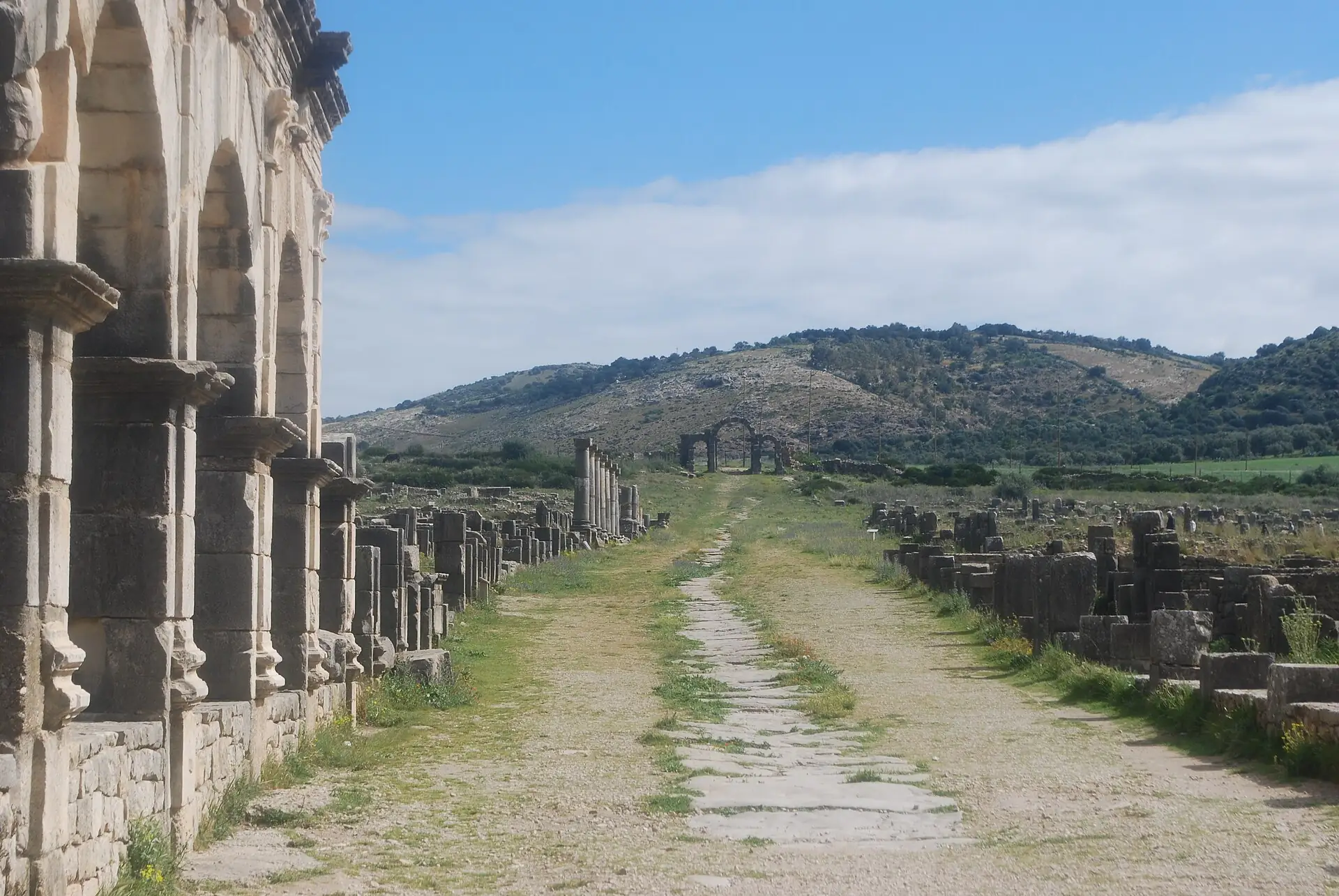
Half an hour from Meknes, on a rise above the olive country of the Zerhoun, stand the most complete Roman ruins in Morocco. Volubilis was once a city of perhaps twenty thousand people — olive oil merchants, magistrates, mosaicists and veterans — and what remains today is not a fragment but a whole legible town: a triumphal arch, a basilica, a capitol, bathhouses, bakery ovens and some of the finest in-situ mosaics anywhere in the Roman world.
This guide is written for travellers planning a visit, usually as part of a route between Fes, Meknes, Chefchaouen or Rabat. It covers what Volubilis actually is, why it matters, what to look for once inside, how to get there, how long to allow, when to go, what to wear and how to combine it with the holy town of Moulay Idriss next door. It deliberately avoids quoting entrance fees and opening hours, which change; your driver or the ticket office on the day will have the current ones.
What is Volubilis?
Volubilis is a UNESCO World Heritage Site and the best-preserved archaeological site in Morocco. It sits in the fertile plain below the Zerhoun massif, roughly 30 kilometres north of Meknes and a little over an hour from Fes — close enough to be easy, far enough to feel like its own world.
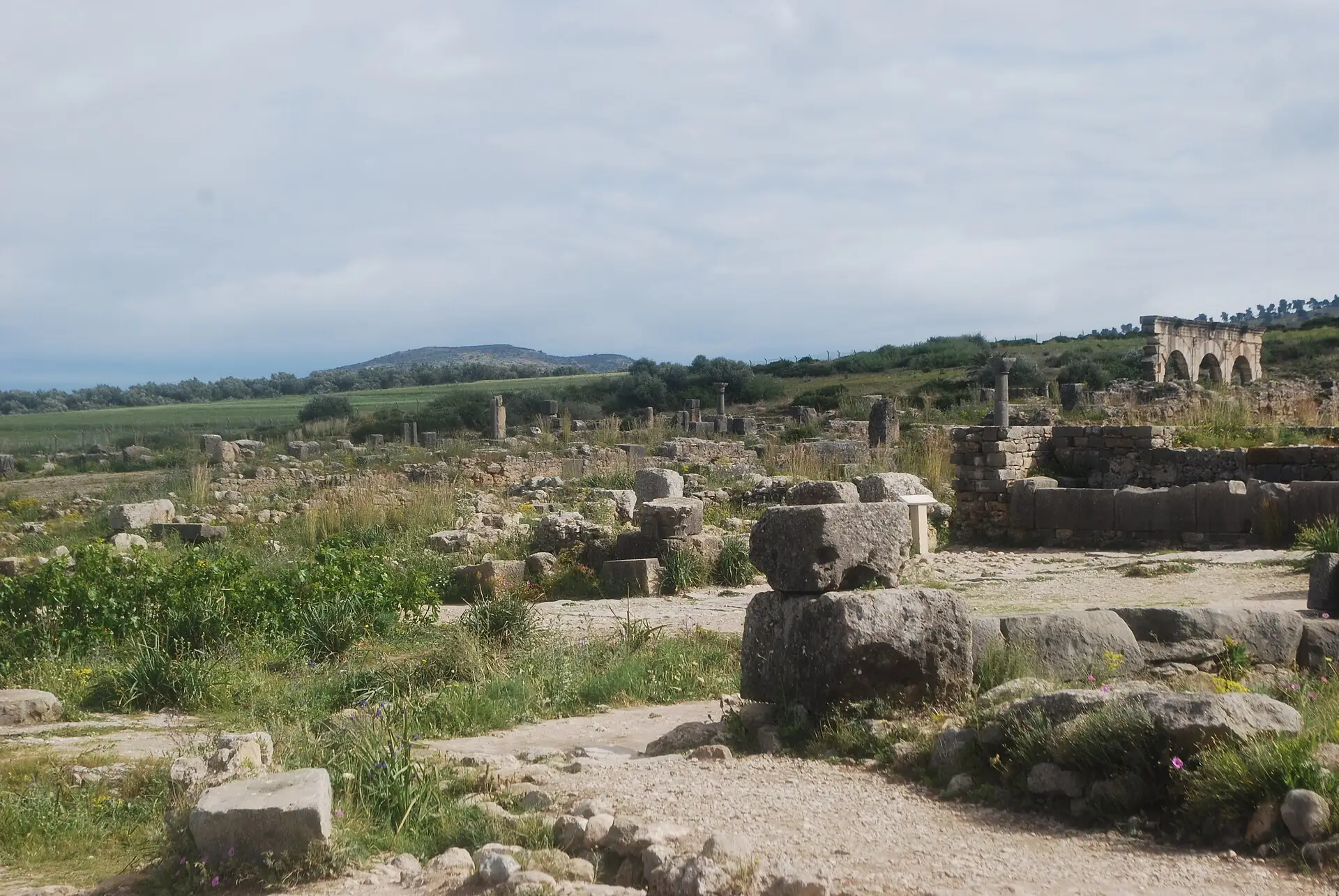
What surprises most visitors is the setting. This is not a roped-off fragment beside a road. The ruins spread across a shallow valley of olive groves and wheat fields, with hills folding away on every side. In spring the site is ringed with green; by summer it turns gold. Storks nest on the columns. It is one of the few ancient sites where the landscape itself explains why the city existed.
A short, honest history
Volubilis was a settlement long before Rome. From around the 3rd century BC it was a Berber — Amazigh — town within the kingdom of Mauretania, trading in the agricultural wealth of the plain. Rome absorbed Mauretania in the 1st century AD, and Volubilis grew into a prosperous municipium of the province of Mauretania Tingitana, its fortunes built largely on olives. The presses are still visible in the ruins of the grander houses.
The city's Roman period peaked in the 2nd and early 3rd centuries. The triumphal arch of Caracalla was raised in 217 AD; the basilica and capitol belong to the same confident era. When Rome withdrew from this far corner of the empire around 285 AD, the remarkable thing is that Volubilis did not die. Latin and then early Islamic-era communities continued here for centuries.
It was at Volubilis, in 788 AD, that Idriss ibn Abdallah — Idriss I, founder of Morocco's first Islamic dynasty — was proclaimed. That single event ties the Roman stones to the birth of the Moroccan state, and it is why the site means more to Moroccans than archaeology alone. The 1755 Lisbon earthquake damaged the ruins badly, and marble was later carried off for building in Meknes, but the essential city survives.
What you will actually see
The site is compact enough to walk comfortably in a morning, and the main monuments are easy to identify. In rough order as most visitors move through:
The Triumphal Arch of Caracalla
The single most photographed structure in Volubilis, built in 217 AD in honour of the emperor Caracalla and his mother Julia Domna. It was reconstructed in the 20th century and stands exactly where a Roman city's ceremonial arch should: astride the decumanus, the main street, looking out over the valley. Walk through it and look back — the alignment with the basilica and capitol is deliberate.
The Basilica and Capitol
The civic heart of the city. The basilica's standing columns frame the law court and administrative spaces; the adjacent capitol was the temple of the state gods. This cluster is where Volubilis feels most like a provincial Rome — and where the scale of the city's ambition is clearest.
The mosaics
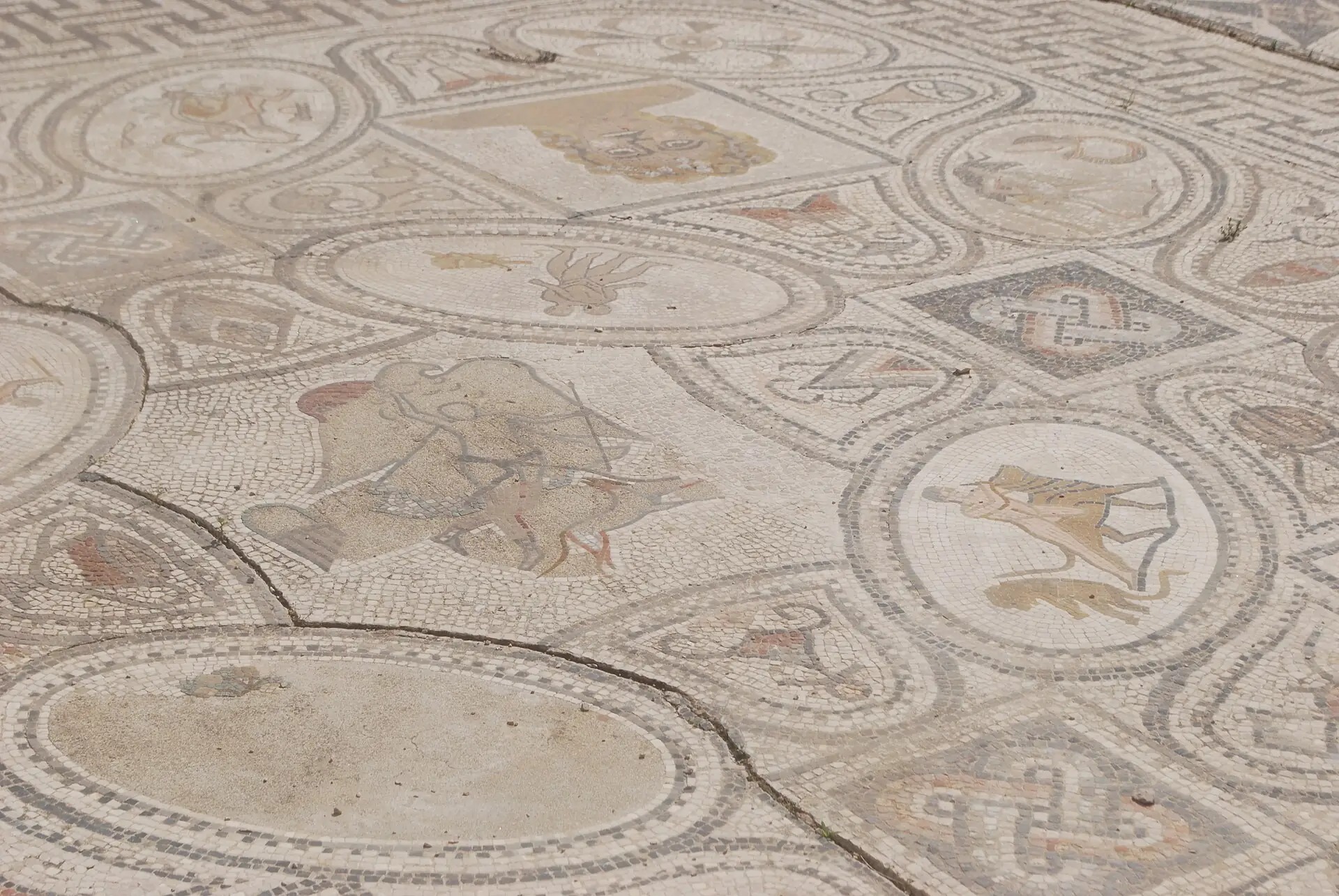
The reason many travellers come. Volubilis is exceptional because its mosaics were left in place rather than lifted into a museum. The finest include the Labours of Hercules, the Four Seasons, the Bacchus scenes and the famous acrobat mosaic in the House of the Acrobat. They sit in the floors of wealthy townhouses, open to the sky. Colours fade slowly in the Moroccan light, which is an argument for visiting sooner rather than later — and for never walking on them.
The houses of the olive-wealthy
The House of Orpheus, the House of the Athlete, the House of the Ephebe and their neighbours follow a recognisable pattern: entrance corridor, columned courtyard, reception rooms with mosaic floors, and at the back an olive press with its stone counterweights. Once you have seen two or three presses you understand the whole economy of the city.
Baths, bakeries and the everyday city
The public baths still show their underfloor heating systems, and the arches of a bakery's ovens survive near the northern quarter. These modest ruins are often what visitors remember most, because they make the city feel inhabited rather than monumental.
How to get to Volubilis
Volubilis sits on the road between Meknes and Moulay Idriss, signposted from the N13. Realistic private-vehicle timings:
- From Meknes — around 30 to 40 minutes.
- From Fes — around 1 hour 15 minutes to 1 hour 30 minutes.
- From Chefchaouen — around 2 hours 30 minutes, making it a natural stop on the road south to Fes.
- From Rabat — around 2 hours.
There is no practical public transport to the site itself; the closest buses and grand taxis reach Meknes or the turning for Moulay Idriss, with an onward taxi for the last stretch. This is why most visitors come with a private vehicle — the site sits naturally on transfer days between the northern cities, and stopping costs almost no time at all.
How long to allow
Two to three hours is the honest answer for the ruins themselves: long enough to walk the main street, stand in the basilica, look properly at four or five mosaics and sit for ten minutes in the shade of the arch. History-focused travellers happily spend half a day. Add an hour if you are combining the visit with lunch or a walk up to Moulay Idriss, which overlooks the site from its twin hills a few kilometres away.
We would gently warn against the thirty-minute coach-tour version. Volubilis rewards slowness: the details — a dolphin in a fountain niche, a press stone, a Latin inscription — are the experience.
Do you need a guide?
You can walk Volubilis alone with a site map and enjoy it. But a licensed local guide transforms the visit, because almost nothing at the site is labelled in depth and the meaning lives in the details: which mosaic belonged to which house, how the presses worked, why the arch faces the way it does, what happened in 788 AD and why it matters. Official guides wait at the entrance and can be engaged on the spot; on a private journey we arrange one as part of the day so the price and the language are settled before you arrive.
When to visit
Volubilis is an open site with very little shade, so the time of day matters more than the month of the year. Aim for the first two hours after opening or the last two hours before closing. Midday in summer is genuinely punishing; midday in winter can be perfect.
- March to May — the site at its most beautiful, with wildflowers among the stones and green hills around it.
- June to August — visit early morning only; the plain bakes by late morning.
- September to November — golden light, thinning crowds, comfortable temperatures.
- December to February — bright, cool and often nearly empty. Bring a layer; the wind moves through the valley.
Fridays bring local visitors and a livelier atmosphere. The Moussem of Moulay Idriss, usually in late summer, fills the whole area — worth knowing about whether you want to attend or avoid it.
What to wear and bring
- Closed, comfortable shoes with grip — paths are uneven stone and worn marble is slick.
- A hat, sunglasses and high-factor sun protection; shade is scarce.
- Water, especially from late spring to early autumn.
- Shoulders and knees comfortably covered is the local norm and the respectful choice, particularly if you continue to Moulay Idriss, a town of pilgrimage.
- Small change in dirhams for the ticket office and guide.
Combining Volubilis with Moulay Idriss and Meknes
The classic pairing is Volubilis plus Moulay Idriss Zerhoun, the whitewashed hill town where Idriss I is buried. From the terrace viewpoints above its rooftops you look directly down on the ruins — one of the finest views in northern Morocco. The town's main square and pilgrimage quarter are welcoming, and lunch here is a pleasure in itself.
Adding Meknes makes a full and coherent day: the granaries and stables of Heri es-Souani, the monumental Bab Mansour gate and a quieter, less visited medina than Fes. From Fes, the triangle of Volubilis–Moulay Idriss–Meknes is the region's essential day, and it slots naturally into any Morocco itinerary that passes through the north. Travellers crossing between Chefchaouen and Fes can fold Volubilis into the transfer itself — the route practically demands it.
Volubilis within a longer Morocco route
Almost every well-built northern itinerary touches Volubilis once. On our own routes it most often appears in three shapes: as a half-day from Fes for travellers who want depth without moving hotels; as a stop on the Chefchaouen–Fes transfer day; and inside longer imperial-cities journeys such as the Imperial Cities & Desert route, where it provides the classical counterpoint to Fes and Marrakech. It pairs equally well with the heritage focus of the Jewish Heritage journey for travellers interested in Morocco's layered past.
What we would not do is treat it as a box to tick between two bigger names. The site deserves its morning, and the valley around it — olives, vineyards, the hill towns of the Zerhoun — is among the gentlest landscapes in the country.
Responsible visiting
Volubilis has survived two thousand years; small choices keep it intact. Stay on the paths and never walk or sit on mosaics, even where others do. Do not climb on walls or columns. Take litter out with you. Ask before photographing the site staff or local families visiting. And buy the olives and olive oil sold at the roadside stalls on the approach road if you want a souvenir — it is the same product the Roman city was built on, and the money stays in the valley.
Frequently asked questions
Is Volubilis worth visiting?
For almost every traveller passing through northern Morocco, yes. It is the country's finest Roman site, a UNESCO World Heritage Site, and it sits directly on the natural routes between Fes, Meknes and Chefchaouen. Even travellers indifferent to archaeology tend to be moved by the setting and the mosaics.
How much time do you need at Volubilis?
Two to three hours for the ruins at a comfortable pace, plus an hour if you add Moulay Idriss. Half a day is not wasted if history interests you.
Can you visit Volubilis from Fes?
Easily. It is around an hour and a quarter by road, and the most popular version of the day combines Volubilis, Moulay Idriss and Meknes before returning to Fes for dinner.
Is Volubilis suitable for children?
Yes — it is one of the few major sites where children can move freely in open space, and the mosaics, storks and olive presses hold their attention. Bring hats, water and closed shoes, and keep the visit to the cooler hours.
Do you need a guide at Volubilis?
Not strictly, but a licensed site guide adds a great deal, since on-site interpretation is minimal. Guides are available at the entrance; on private journeys we arrange one in advance.
What should you wear to Volubilis?
Comfortable closed shoes, sun protection and clothing that covers shoulders and knees — the practical and respectful norm in the region, especially if you continue to Moulay Idriss.
When is the best time of day to visit?
Early morning or late afternoon, in every season. The site is exposed, the light is best at the edges of the day, and the crowds — such as they are — peak at midday.
Is Volubilis open all year?
Yes, the site operates year-round, with seasonal hours. Exact times and ticket prices change, so confirm on the day through your driver or at the ticket office rather than relying on any website, including ours.