A short drive north of Tata, in a fold of the southern Anti-Atlas, stands a fortified building that looks like a small castle and functioned like nothing of the sort. The collective granary of Aït Kine is one of Morocco's most complete surviving igoudar: a communal strongroom of some seventy-five family chambers, held together for generations by rules rather than by rulers. It is not a monument that was abandoned and later admired. It is an institution that the village never entirely let go of.
A note before anything else: Aït Kine is not Aït Ben Haddou. The two names are frequently confused, including online. Aït Ben Haddou is the famous fortified ksar — a village of houses — on the Ounila valley route near Ouarzazate, several hundred kilometres to the north-east. Aït Kine is a single collective granary in the Anti-Atlas near Tata, with a different purpose, a different landscape and a fraction of the visitors. If an article, image or itinerary blends them, it is describing two different places.
What an agadir is — and what it is not
In the Amazigh south, an agadir (plural igoudar) is a fortified collective granary. The word predates and is unrelated to the modern Atlantic city of the same name. An agadir is not a fortress with a garrison, not a palace and not a religious complex, though it borrows defensive language from all of them.
Its function was storage under collective protection. Behind a single controlled gate, dozens of small chambers were allocated to individual households. A family held recognised rights over its own cell and its own key; the walls, the gate, the cistern and the guardianship were maintained in common. Grain and seed were the core of it, but chambers also held oil, dates, almonds, dried food, textiles, jewellery and — crucially — written documents recording land, marriage and inheritance.
Describing an agadir as a "community bank" is a useful shorthand as long as it is understood as analogy. No credit was issued and no interest was charged. What was protected was the thing a pre-industrial mountain household could least afford to lose: next year's seed, this year's food, and the paperwork proving what belonged to whom.
Where Aït Kine is
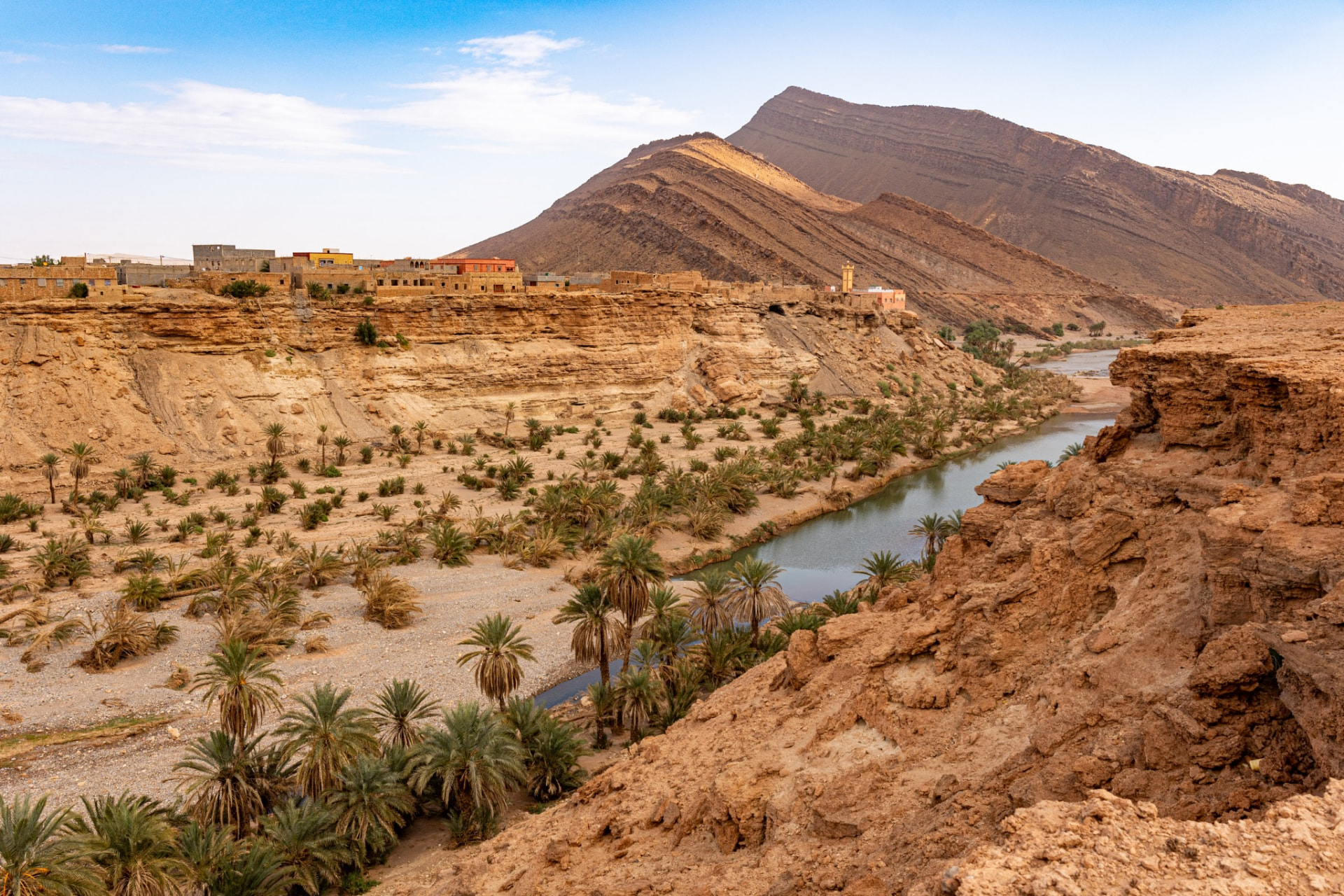
Aït Kine (also written Ait Kine or Ayt Kin) is an Amazigh village roughly 45–50 kilometres north of Tata, in Morocco's Souss-Massa region, reached via the Tleta Tagmoute area on the road towards Igherm. The country here is dry mountain and rocky plain, punctuated by oases where water allows cultivation — an environment that explains both the need to store and the need to defend.
Tata is the practical base for the area. Igherm sits on the longer Anti-Atlas axis towards Taroudant, and the whole zone lies well off the Marrakech–Fes circuit that most visitors follow. That remoteness is the reason the granary survived with its community relationship intact, and it is also the reason a visit needs planning.
Inside the granary
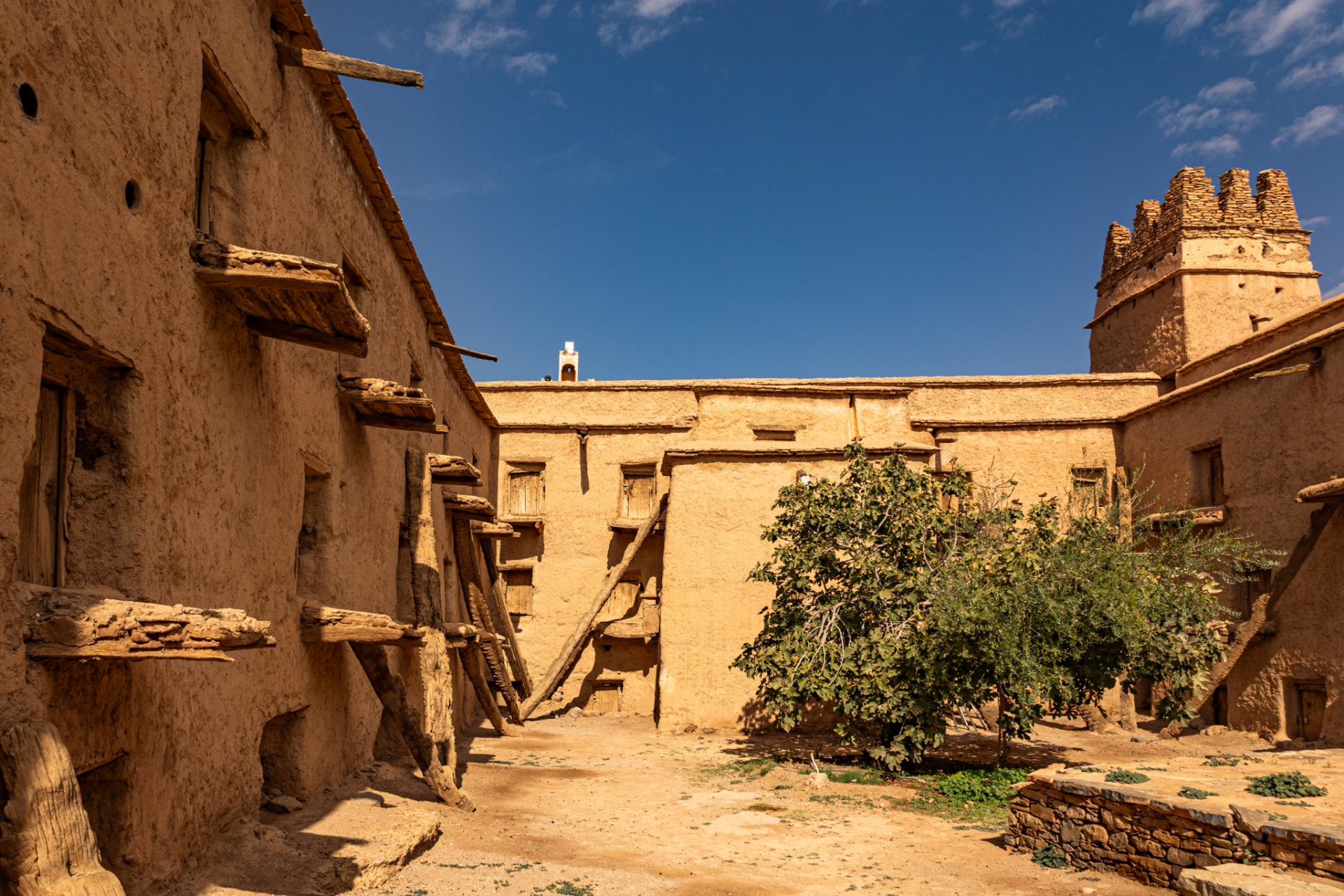
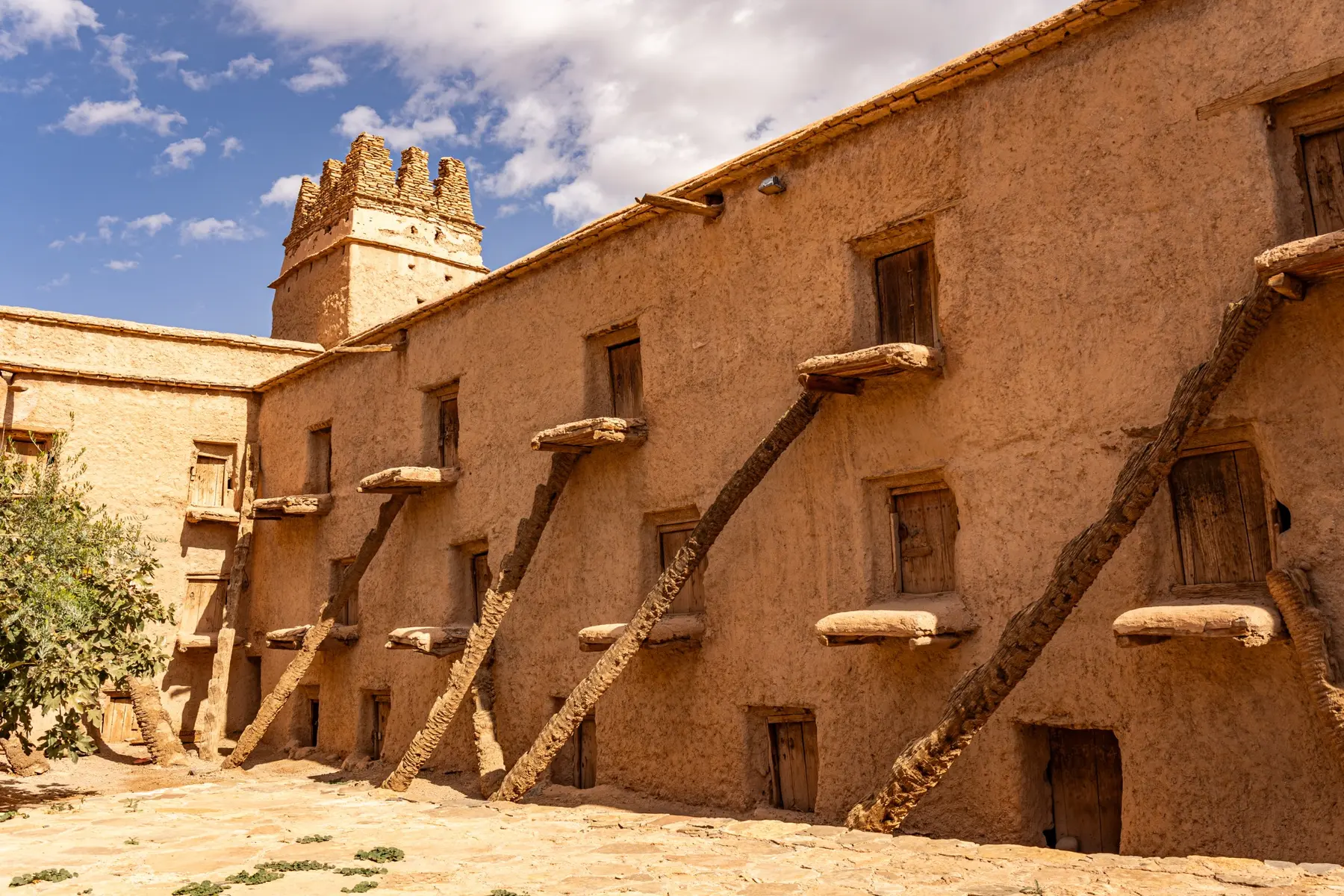
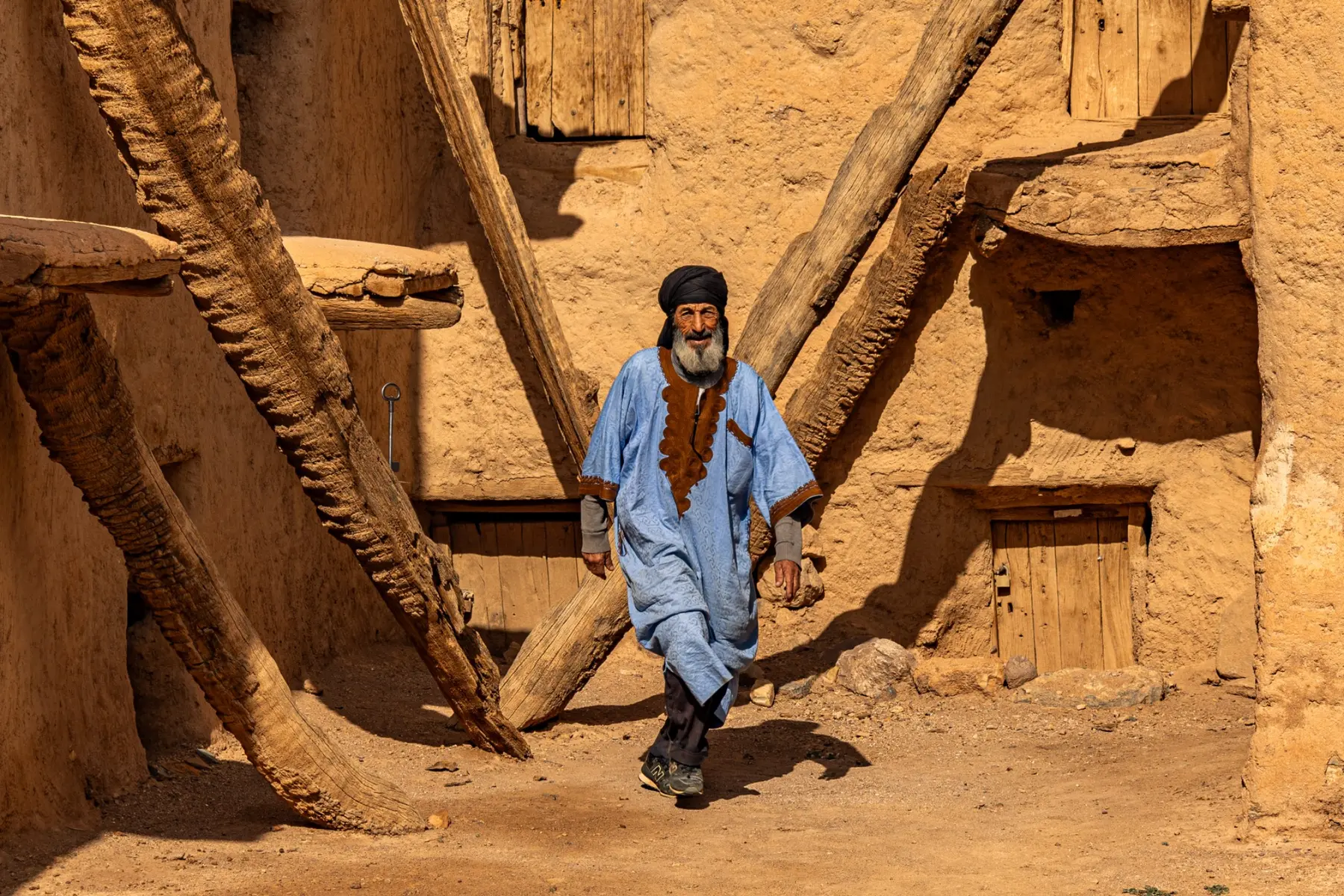
You enter through a single fortified gateway into a courtyard, and the building immediately explains itself. Around and above you, small wooden doors open onto individual chambers stacked across several levels. Access to the upper cells is by projecting stone steps set into the wall and by long angled timber or palm-trunk supports — an ingenious, entirely local solution to vertical circulation without staircases.
Moroccan reporting on the site records 76 rooms: one associated with each family plus an additional collective chamber; other descriptions give around 75 chambers. The safest statement is that the agadir holds roughly seventy-five family cells arranged on multiple levels, with shared space in addition. Exact historical inventories differ, and it would be dishonest to present one number as settled fact.
The rest of the architecture is climate and security in built form: thick earthen walls with high thermal mass; small openings that limit heat gain and intrusion; bastioned towers at the corners; a heavy carved wooden door; roofs of timber, brushwood and earth with slate detailing; and an internal cistern so the building could hold water independently of the village below.
How it worked as an institution
The architecture is only half the achievement; the governance is the other half. An agadir depended on a set of customary rules — who could enter, when, under whose supervision, what maintenance each household owed, how disputes were settled, what happened to a chamber when a family line ended. These systems varied between valleys and tribes, so it is wrong to describe one universal Moroccan granary law. The shared principle, however, is consistent and remarkable: private property secured inside a collectively financed and collectively policed structure.
The guardian
A guardian or caretaker traditionally held responsibility for the gate, for the condition of the fabric and for upholding the community's rules. This was not simply a watchman's job. It required knowing the families, the rights attached to each chamber and the state of every roof and wall. A version of that custodial relationship continues today, which is exactly why visitors should follow local guidance rather than treat the building as open ground.
Age, restoration and why the building still stands
Aït Kine is generally associated with the 18th century, and is often described as more than two hundred years old. Precise dating is not universally established: earthen buildings are repaired continually, and fabric rarely gives a single construction year. Century-level dating is the honest register.
What is documented is the conservation work. An initial restoration was begun by the local association in 2004. A further safeguarding phase led by the architect and anthropologist Salima Naji — long associated with southern Morocco's earthen heritage — started around 2012 in partnership with the Amoudou association and with support from the U.S. Ambassadors Fund for Cultural Preservation, and was completed around 2013. The work addressed water penetration, foundations, terraces, slate roof detailing, facades, the cistern and earlier inappropriate cement repairs.
That last point matters. Cement is the most common way a well-meaning repair kills an earthen building: it traps moisture inside walls that were designed to breathe. Conservation here means compatible earth, stone, lime and timber, executed by craftspeople who know the technique — and, above all, continued maintenance.
The Anti-Atlas context: a landscape of granaries
Aït Kine is not an isolated marvel. Hundreds of igoudar have been documented across the High Atlas, Anti-Atlas and the pre-Saharan oases, each adapted to its own materials and terrain: more stone where stone is plentiful, more earth and palm timber in the oases, cliff-top siting where the rock offered defence. Seen together, they describe a regional civilisation of storage.
The clearest comparison for travellers is Amtoudi, where two granaries stand above a spring-fed palm gorge to the south-west. Amtoudi shows the type at its most dramatic in landscape terms; Aït Kine shows it at its most intact in social terms. Visiting both, in either order, is the most convincing way to understand igoudar as a system rather than as scenery. UNESCO's tentative lists and Morocco's heritage bodies document a number of related earthen sites for readers who want to go further.
Visiting respectfully
Aït Kine is living heritage in a small village, and the ordinary rules of a museum do not apply — a stricter set does.
- Access is not guaranteed. Entry depends on the custodian being present. There is no dependable published schedule, and it is unreasonable to demand one. Build flexibility into the day.
- Never open or enter a chamber uninvited. Stored goods, where present, remain family property.
- Keep to permitted routes. Timber supports and projecting steps are original fabric and are not designed for casual traffic.
- Photograph the architecture, ask about people. Consent first, every time.
- Support locally. Engage the guide or association, buy tea, contribute where a community fund exists. Maintenance is paid for locally.
- Dress modestly and keep noise low. You are in the middle of a village, not at an attraction.
Planning a visit
Route and driving
Aït Kine is reached from Tata, on mountain roads that reward an unhurried pace. Most travellers include it either on a southern Anti-Atlas crossing between Taroudant/Igherm and Tata, or as part of a wider loop linking the Draa valley, Tata and the Atlantic south. Journeys in this region are measured in driving days rather than driving hours, and we travel them privately with a driver-guide who knows the current condition of the roads.
Seasonality
Autumn and spring are generally the most comfortable. Winter days are usually pleasant with cold nights and superb clarity; summer is hot enough that visits are best confined to early morning. Rainfall is rare but can affect roads for a short period. See our seasonal guide for the wider picture.
Practicalities
Bring water, sun protection, sturdy shoes and cash in small notes. Mobile coverage is intermittent. Facilities in the village are limited, and accommodation is typically arranged in or near Tata rather than at the granary itself.
Frequently asked questions
Is Aït Kine the same as Aït Ben Haddou?
No. Aït Ben Haddou is a fortified village near Ouarzazate on the old Tizi n'Tichka trade route. Aït Kine is a collective granary near Tata in the Anti-Atlas. Different buildings, different purposes, different regions.
Can I go inside?
Sometimes, with the custodian's agreement. It is not guaranteed and should not be assumed. The exterior, setting and courtyard architecture — where access is permitted — already justify the detour.
How long should I allow?
An hour or two at the site is usually enough to see it properly with an explanation; the driving to and from it is what shapes the day.
Is it still used?
The building has retained a relationship with its community rather than becoming purely archaeological. That does not mean every chamber is in daily use as it was two centuries ago, and it would be misleading to suggest so.
Is it suitable for children or travellers with limited mobility?
The approach and courtyard are manageable for most; upper levels are not, and were never intended to be. A private itinerary can adjust easily.
Can Aït Kine be combined with the desert?
Yes. The Tata region connects naturally eastwards towards the Draa and the dunes; see our Sahara journeys. Longer private routes are shown in the Journeys collection, and culturally focused days in Experiences.
Build it into a route
Aït Kine is a specialist stop, and it works best in the hands of someone who can place it in context and read the day's conditions. If a southern Anti-Atlas route interests you — granaries, oases, Amazigh architecture, and the driving days that connect them — tell us what you would like to see and we will design it around your dates and pace.