Where you sleep in Morocco changes the trip more than almost any other decision. Two travellers can follow an identical route through Marrakech, Fes and the south and come home with completely different impressions, largely because one of them stayed in a converted courtyard house inside the old city and the other stayed in a hotel on a ring road. Neither choice is wrong. But the words used to describe them — riad, dar, maison d'hôte, boutique hotel — are used loosely, and the differences that actually affect your stay are rarely the ones highlighted in photographs.
This guide explains what a riad is, how it differs from other accommodation, and the practical trade-offs that decide whether a particular one suits you: location, stairs, noise, light, pools, rooftops, breakfast, family suitability and privacy. It also covers how the answers change between cities, what to ask before booking, and how we select accommodation for our own guests.
What a riad actually is
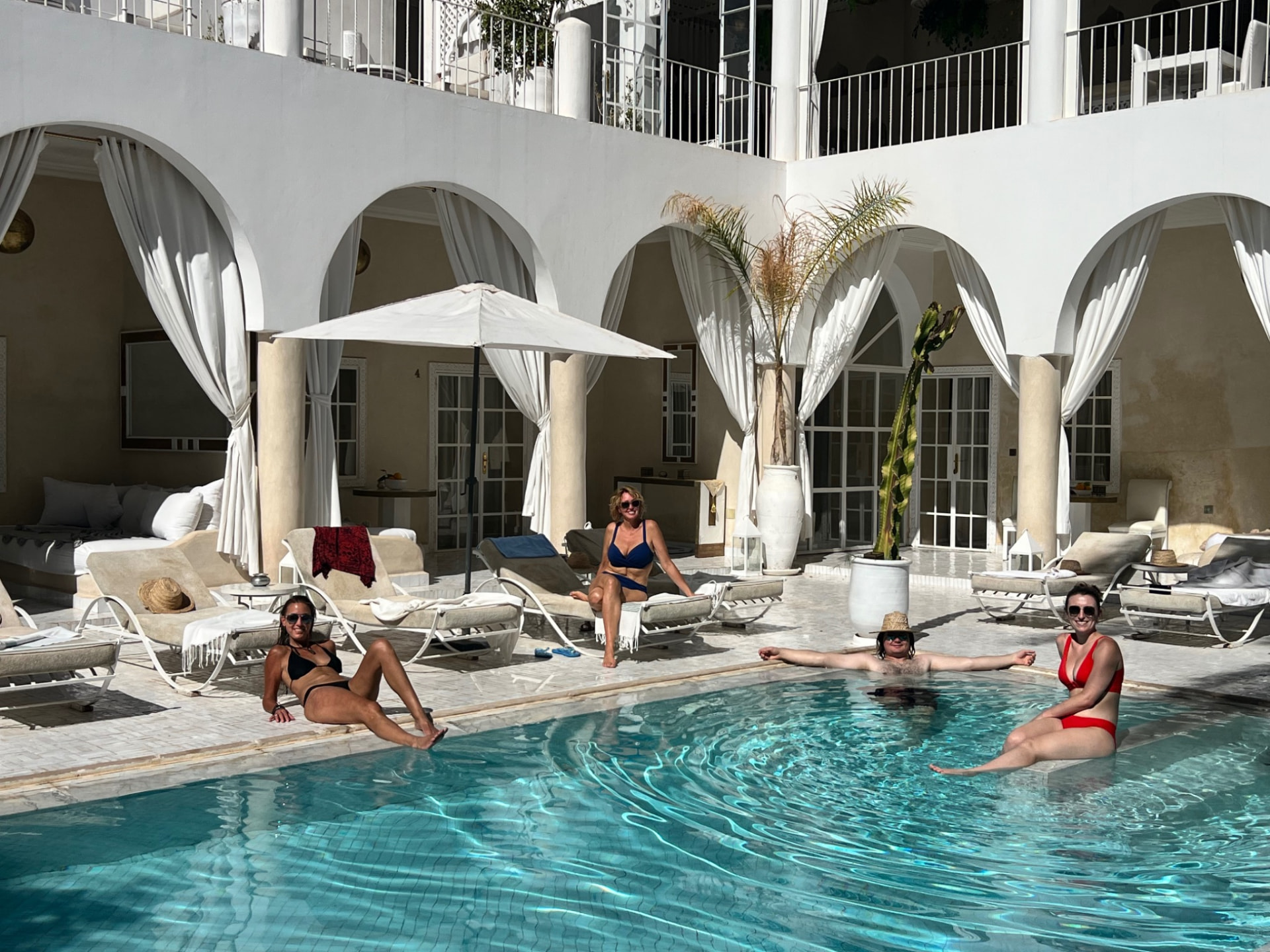
A riad is a traditional Moroccan house built around an interior courtyard, historically with a garden at its centre — the word derives from the Arabic for garden. Rooms face inward onto that courtyard rather than outward onto the street. From the lane outside, a riad is usually anonymous: a plain wall, a single door, no windows to speak of. Inside, the building opens upward into light.
That inward orientation is not decorative. It provided privacy for family life, shade and cooling through the hot months, and security in dense urban quarters. It also explains most of the practical characteristics of staying in one: quiet inner rooms, an acoustically live central space, vertical circulation by staircase, and a rooftop that functions as the house's outdoor room.
Riad, dar, maison d'hôte and hotel
- Riad — courtyard house, historically with a garden; today used for restored houses operating as guest accommodation.
- Dar — a traditional house, typically smaller, sometimes with a light well rather than a true garden courtyard. Many properties marketed as riads are strictly dars, and this is not a problem in itself; it usually just means a more intimate building.
- Maison d'hôte — a guest house, an operating category rather than an architectural one. Often a riad or dar, sometimes a modern villa.
- Hotel — conventional accommodation, usually in the newer parts of a city, with lifts, parking, larger public spaces and more standardised service.
- Kasbah / ksar accommodation — in southern Morocco, earthen-architecture buildings restored as guest houses. Different tradition, different climate logic, similar intimacy.
The label matters far less than the specifics. A twelve-room riad with a restaurant behaves like a small hotel; a four-room dar behaves like a private house.
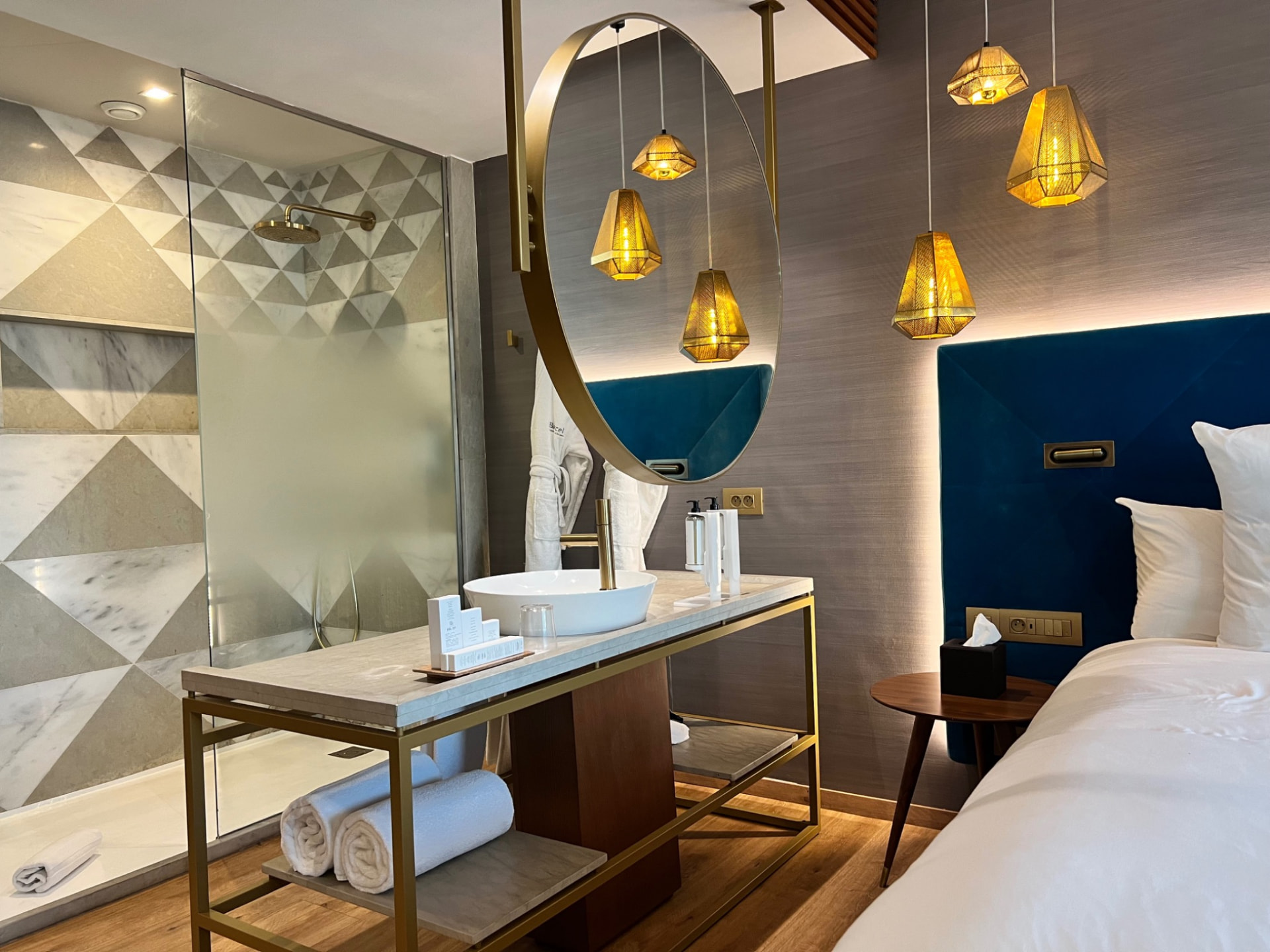
Location: the trade-off nobody explains clearly
Inside the medina you are in the historic city. You step out of the door into the life of the place, you walk to most sights, and evenings feel entirely different. The costs are real too: vehicles cannot reach most riad doors, so arrival means walking the last stretch with your luggage, sometimes several minutes through lanes; navigation takes practice; and deliveries, taxis and late arrivals all require a little coordination.
Outside the medina — Marrakech's Gueliz and Hivernage, Fes's Ville Nouvelle — you gain vehicle access, parking, lifts, wider streets and easier logistics, and you lose immediacy. You will take a taxi to reach the old city each day, and the evening atmosphere is ordinary urban rather than historic.
A useful way to decide: if the medina is the reason you are visiting, stay in it. If the city is a base for day trips and you value ease of movement, stay outside it. On longer routes we often mix both deliberately — medina nights where the old city is the point, modern hotel nights where a very early departure or a late flight makes access matter more.
Within the medina, position still matters
Not all medina addresses are equal. A riad a few minutes from a main gate is far easier for arrival, departure and taxis than one deep in the interior. Proximity to a square, a busy souk street or a café terrace affects noise. Proximity to a mosque affects the volume of the call to prayer, which some travellers love and others find disruptive at dawn. Ask specifically: how far is the nearest vehicle access point, and how long is the walk?
The building itself: what to check before booking
Stairs and accessibility
This is the single most common mismatch. Traditional houses are vertical: rooms on two or three floors around the courtyard, plus a roof terrace, connected by stairs that are often steep, narrow, tiled and sometimes irregular. Lifts are rare. There is frequently a step at the entrance and uneven ground in the lane outside.
If anyone in your party has mobility limitations, a knee problem, a heart condition, or is travelling with a small child and a pushchair, ask directly: how many steps from the street to the room, are there ground-floor rooms, is there a handrail, and how steep are the stairs to the terrace? Photographs never show this. Some riads have genuinely comfortable ground-floor rooms; many do not.
Room layout, light and temperature
Because rooms face inward, natural light varies enormously. Ground-floor rooms are the coolest and most private but often the darkest. Upper-floor rooms get more light and better views but more sound from the courtyard and more stairs. Some rooms have no exterior window at all — perfectly comfortable, but worth knowing if you dislike windowless spaces.
Heating and cooling deserve a direct question. Thick walls keep the house cool in summer, which is a genuine advantage; the same mass makes winter interiors cold, and Marrakech and especially Fes get properly cold at night from late autumn to early spring. Ask whether rooms have effective heating and air conditioning rather than assuming.
Noise and acoustics
A courtyard is a sound chamber. Conversation, breakfast service, footsteps and music travel upward and echo. In a small riad this is charming; in a busy one it can mean a lively courtyard dinner directly below your room. If you are a light sleeper, request a room away from the courtyard's open side or on the quietest floor, and bring earplugs regardless. Outside noise — early-morning deliveries, the call to prayer, nearby cafés — depends on the address, not the building.
Pools and plunge pools
Most medina riads have, at best, a small plunge pool in the courtyard: cooling, atmospheric, often shaded and unheated, and not for swimming lengths. In winter such a pool is essentially decorative. If actual swimming matters — for children, or for a hot-weather trip — look at properties outside the medina, at palmeraie or countryside hotels near Marrakech, or ask whether the pool is heated and how much sun the courtyard receives.
Rooftops
The roof terrace is often the best space in the house: breakfast in the morning sun, drinks at dusk, city views and, in Marrakech, the Atlas on clear days. Ask whether it is furnished and shaded, whether meals are served there, and whether it is shared with a restaurant open to non-residents, which changes the atmosphere considerably.
Breakfast and food
Breakfast is usually included and is one of the pleasures of a good riad: fresh breads, msemen or baghrir, local honey, jam, eggs, fruit, coffee and mint tea, served in the courtyard or on the roof. Dinner is more variable. Many riads offer a set home-cooked dinner on request, booked earlier in the day; this can be excellent and is a good option on your first night when you are tired. Others do not cook at all. If you have dietary requirements, state them at booking rather than on arrival — the kitchen is small and shops for particular items in advance.
Family suitability and privacy
Riads can be superb for families or difficult for them, and the difference is specific. In favour: many have interconnecting rooms or suites, staff are typically warm with children, the enclosed courtyard is safe and contained, and a small property feels like your own house. Against: stairs, hard tiled surfaces, occasional low balustrades, plunge pools without fencing, and the impossibility of getting a car to the door.
For a family, ask about interconnecting rooms, a ground-floor option, whether the terrace and stair balustrades are high, whether the pool can be supervised or covered, and whether cots and early meals are available. For groups or multi-generational travel, hiring an entire small riad is often better value and far more comfortable than booking several rooms in a larger one — exclusive use removes the shared-courtyard question altogether.
On privacy generally: a riad is a shared house. You will encounter other guests at breakfast and in the courtyard, and staff move through the building. Travellers who want anonymity are often happier in a hotel or in an exclusive-use property. Travellers who want to be looked after by name usually prefer the riad.
Authenticity versus luxury
These are not opposites, but they are not the same thing either. A carefully restored historic house with traditional zellige, carved plaster and cedar ceilings may have modest bathrooms and no lift. A high-end property may have superb bedding, water pressure, heating and service in a building that was largely rebuilt. Both are valid; the mistake is expecting one and booking the other.
Be sceptical of "authentic" as a marketing word. What actually distinguishes a good riad is craftsmanship that is real rather than applied, staff who have worked there for years, food cooked in the house, maintenance that has kept pace, and honest photographs. Read recent reviews for the same details you would ask about: water temperature, heating in winter, noise, stairs, and how the property handled a problem.
How the cities differ
Marrakech
The largest and most developed riad scene, with everything from four-room houses to substantial luxury properties. The medina is flatter and, in parts, more navigable than Fes; taxis and vehicle drop-off points are relatively accessible. Marrakech is also where the widest range of alternatives sits — palmeraie hotels, countryside properties with real pools, and modern hotels in Gueliz — which makes it the easiest city in which to match accommodation precisely to a trip.
Fes
Fes el Bali is denser, hillier and harder to navigate, and its riads are often larger and more architecturally spectacular, occupying merchant houses of real scale. The trade-offs are sharper: longer walks from vehicle access, steeper lanes, and colder winters. The reward is that Fes at night, from a rooftop, is one of the great experiences in Morocco. Our Fes experiences are built around that density.
Essaouira and the coast
Smaller riads and dars within compact ramparts, with Atlantic wind, salt air and sea light instead of a hot courtyard. Humidity and wind are the practical variables; heating matters here too.
Chefchaouen and the north
Mostly small guest houses rather than grand courtyard houses, on steep streets, with terraces overlooking the blue town.
The south, the Atlas and the desert
Different traditions entirely: kasbah and ksar guest houses in earthen architecture, mountain lodges, and desert camps. Comfort levels range widely, and the questions that matter shift to heating, water supply, electricity hours and how far the property is from the road. Our Sahara journeys and signature journeys pair these deliberately with medina nights so the contrast becomes part of the route.
Questions worth asking before you book
- How far is the nearest vehicle access, and how long is the walk to the door?
- How many steps from the street to my room? Is a ground-floor room available?
- Does the room have an exterior window, heating and air conditioning?
- Is the room on the courtyard? How lively is the courtyard in the evening?
- Is the pool heated? How much sun does the courtyard get in my travel month?
- Is the terrace shared with a public restaurant?
- Is dinner available, and can dietary requirements be accommodated?
- Is airport or medina-gate assistance with luggage provided?
- Is exclusive use possible for our group, and what does that include?
A property that answers these clearly and specifically is usually well run. Vague answers are informative in themselves.
Responsible choices
Restored riads have kept a great deal of medina architecture standing, and they employ local staff, cooks and craftspeople. They can also displace residents when whole quarters convert to guest accommodation. You can weight your choice toward the better end of that spectrum: favour properties that employ locally and say so, that use Moroccan craftspeople for restoration and furnishing, that source food from the local market, and that behave as part of the neighbourhood rather than sealed off from it. Water is a genuine constraint in Marrakech and the south — short showers and reused towels are not gestures here. And treat the medina as a residential area, because it is one: quiet arrivals late at night, modest dress in the lanes, and permission before photographing people.
How Morocco Shiny Days selects accommodation
We do not work from a fixed list. For each journey we match the property to the travellers and to the position of that night in the route: a small, quiet dar for a first night after a long flight; a larger riad with a real terrace where you have two full days in the city; a hotel with parking and a lift when a pre-dawn departure makes medina logistics unkind; exclusive use for families and groups where it makes sense.
Selection is based on places we have visited and used repeatedly, on the consistency of the staff, on how the property handles problems rather than how it photographs, and on practical fit — stairs, heating, noise, breakfast, walking distance. We tell you the trade-offs of each choice honestly before it is confirmed, including where a beautiful property has a genuine drawback. We do not claim partnerships, ratings or guarantees we cannot substantiate, and availability at any particular property is confirmed at the time of planning rather than promised in advance.
Frequently asked questions
Is a riad better than a hotel in Morocco?
It is different. A riad gives atmosphere, intimacy and a medina address; a hotel gives lifts, parking, pools and predictability. Many good itineraries use both.
Are riads suitable for older travellers?
Some are, many are not, and the deciding factors are stairs and the walk from vehicle access. Ground-floor rooms exist but must be requested and confirmed specifically.
Are riads safe?
Riads are private houses with staffed entrances and are generally very secure. The usual city-travel common sense applies in the lanes outside, particularly at night.
Do I need to book the whole riad for a family?
Not necessarily, but exclusive use of a small property is often more comfortable and better value than several rooms in a larger one.
Will it be cold in winter?
It can be. Thick walls and courtyards that excel in summer hold the cold in winter, and Fes in particular gets genuinely chilly at night. Confirm heating before booking a winter stay — see our guide to the best time to visit Morocco.
Should I book a riad myself or through a trip planner?
Booking directly is entirely possible. The advantage of planning together is that accommodation is chosen against the whole route — arrival times, departures, walking distances and who is travelling — rather than one night at a time.