
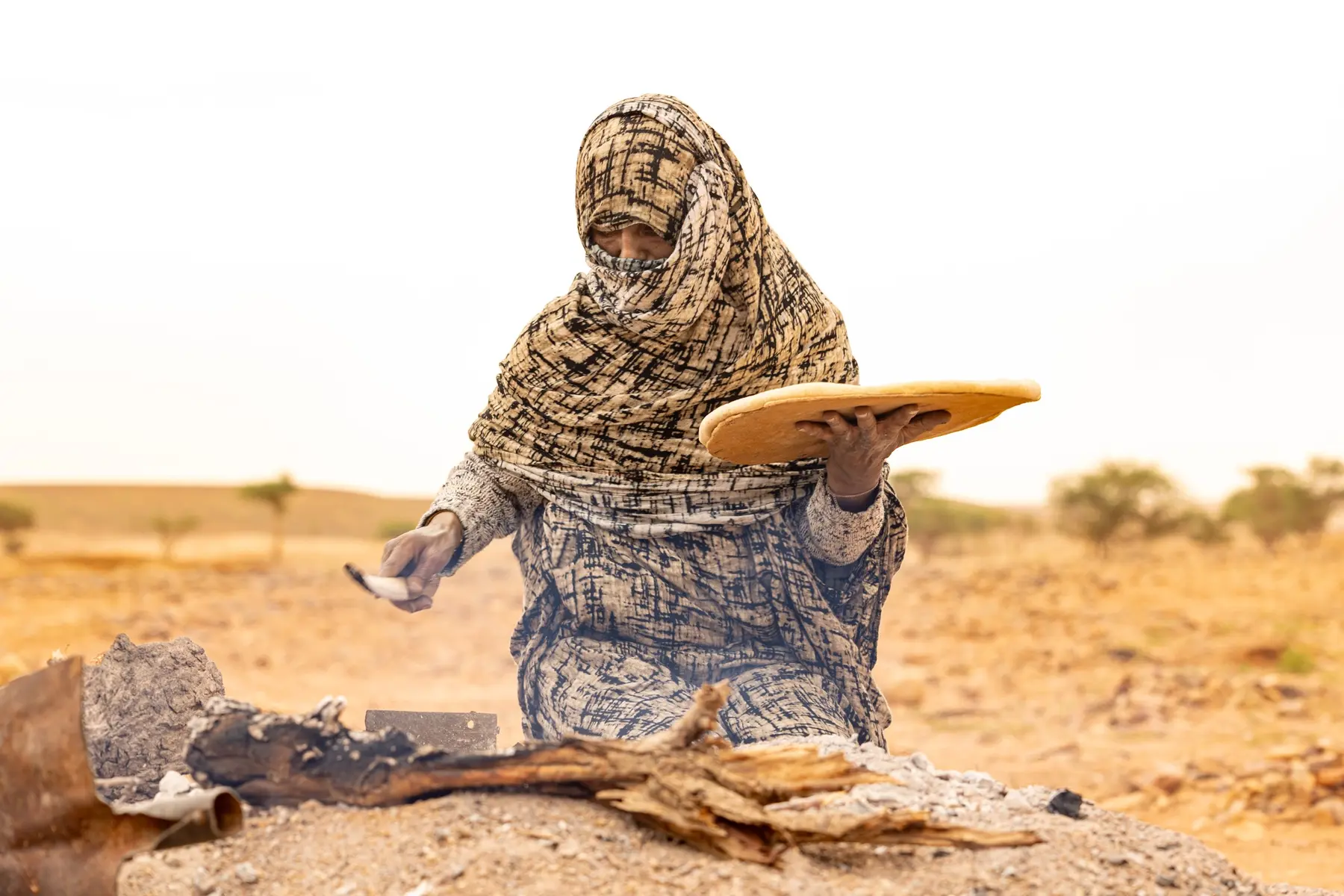
Nomads in Morocco are not one single community, nor does nomadic life mean simply crossing Sahara dunes by camel. Historically, pastoral families in several parts of the country moved between grazing areas according to water, rainfall, temperature, livestock needs and relationships with markets and other communities. Today, some families remain mobile, many move only during part of the year, and others have settled while retaining a strong nomadic heritage.
Understanding this way of life requires looking beyond the familiar desert image. Morocco's nomadic and semi-nomadic traditions belong to mountain plateaus, steppe, pre-Saharan valleys and desert margins as well as the Sahara itself. They have always involved hard physical work, environmental knowledge, trade and adaptation. Modern vehicles, mobile phones and solar panels are now part of that adaptation; they do not erase a family's identity.
Who are the nomads of Morocco?
In simple terms, a nomadic household moves without maintaining one permanent year-round home. A semi-nomadic family combines periods of movement with a fixed base, while transhumant pastoralism describes seasonal movement between established grazing areas—often between warmer lowlands and cooler mountain pasture. A settled family may no longer move with animals but can still have close family, cultural and economic ties to nomadic life.
These categories overlap. One part of a household may remain near a village so children can attend school while other family members accompany livestock. Routes may shorten during drought, change after rainfall, or become possible through trucks and motorcycles rather than long journeys on foot. It is more accurate to think of a range of mobility than a fixed division between “nomad” and “settled.”
Amazigh and “Berber” terminology
Many communities described in older English books and travel writing as “Berber nomads” are Amazigh (plural: Imazighen), the Indigenous peoples of North Africa. Travelers will still encounter both words, and “Berber nomads Morocco” remains a common search phrase, but Amazigh is generally the more appropriate contemporary term. Not all Amazigh people are nomadic, however, and Morocco's nomadic people do not belong to one tribe or share an identical way of life.
Where do nomads live in Morocco?
Nomadic and transhumant traditions developed in response to very different Moroccan landscapes. Mobility might connect a desert margin to a seasonal water source, or a mountain valley to summer grazing at higher elevation. The following regions are important examples, not a complete map of every community.
Southeastern Morocco and the pre-Sahara
The broad southeast—including the Tafilalt, the stony plains beyond the Anti-Atlas and the country approaching the Algerian frontier—has long supported pastoral movement. Rainfall is irregular and good pasture can be widely dispersed. Sheep, goats and camels are kept in different combinations according to the landscape and a household's resources. Towns such as Erfoud, Rissani, Tazzarine, Nkob and Zagora connect remote families with markets, transport and services.
Merzouga and Erg Chebbi
Around Merzouga, the dunes of Erg Chebbi sit beside villages, roads and an established tourism economy. Families in the wider region have nomadic heritage, and some pastoral households continue to move or maintain camps away from the main settlements. At the same time, tourism, schooling, drought and new employment have transformed daily life. The presence of camps, 4x4s or mobile phones should not be confused with the disappearance of local culture; it shows how people respond to changing circumstances.
Jbel Saghro
Between the High Atlas and the Sahara, Jbel Saghro is closely associated with the Aït Atta and with seasonal pastoral movement. Its volcanic massifs, dry valleys and high plateaus can provide winter grazing, while some routes historically connected Saghro with more northerly summer pasture. Conditions are demanding: water points may be far apart, temperatures vary sharply and the value of a grazing area depends on recent rain rather than how green it appears in a photograph.
Draa Valley, M'Hamid and Erg Chigaga
South of the Draa Valley, the transition from oasis settlements to open pre-Saharan country is particularly clear. M'Hamid El Ghizlane is the gateway to off-road routes toward Erg Chigaga, Lake Iriki and Foum Zguid. Pastoral traditions remain part of the region's identity, although the degree of mobility differs from one family to another. If you are deciding how this region fits into a journey, our guide to Erg Chigaga and Erg Chebbi explains the different routes without ranking one desert above the other.
High Atlas and other mountain regions
Nomadism in Morocco is not limited to the desert. Seasonal livestock movement has also connected valleys, plateaus and high summer pastures in the Atlas ranges. Mountain transhumance responds to snow, temperature, access and the timing of plant growth. These communities may have different languages, routes and social histories from pastoral groups in the southeast, which is why a single image of “Sahara nomads” cannot represent the whole country.

The Aït Atta and pastoral life in southern Morocco
The Aït Atta are an important Amazigh confederation whose historical heartland is associated with Jbel Saghro. Their communities extend across a much wider area of southern and southeastern Morocco, and their history cannot be reduced to nomadism alone. Nevertheless, pastoral movement, sheep and goat herding, and connections between Saghro and surrounding regions are central to understanding their relationship with the landscape.
The Aït Khebbach, associated especially with the Tafilalt and southeastern borderlands, are also relevant to the story of mobility and pastoralism. Names, affiliations and practices are complex; turning them into a tourist list of “Moroccan nomadic tribes” would obscure more than it explains. Families within the same broad community may now live in very different ways.
How traditional nomadic life works
Movement is practical rather than aimless. Families assess the condition of pasture, distance to water, health of animals, weather and access to markets before changing location. A good rain can create grazing in a place that was recently bare, while a failed well or prolonged dry period can make a familiar route impossible.
Sheep and goats commonly provide milk, meat, wool or hair and animals that can be sold when cash is needed. Camels remain valuable in some desert regions, though they are neither used by every family nor ridden continually. Donkeys and mules can carry water, fodder and belongings; trucks, motorcycles and 4x4s increasingly perform transport that animals once handled.
A camp is established according to shelter, water and grazing. Traditional tents may be woven from goat hair or other materials, but families also use tarpaulins, manufactured fabric and locally available building materials. Food is prepared with limited water and fuel. Flour, tea, sugar, oil, pulses and preserved ingredients can be purchased at a weekly souk, while milk and other animal products depend on the household and season.
None of this is effortless or picturesque. Herding involves long hours, exposure to heat and cold, veterinary risks, uncertain prices and constant attention to water. Hospitality remains socially important, but an offered glass of tea should not hide the labor required to maintain daily life in an arid environment.
Water: the central issue
Water is the organizing fact of pastoral life. Wells and springs, seasonal rainfall, the distance between water points and the amount of pasture produced by rain all influence when and where livestock can move. A route that worked for one generation may become much harder after repeated drought, falling groundwater or changes in access.
The consequences extend beyond drinking water. Animals need water, women and men may spend hours collecting it, and poor pasture means families must buy fodder or reduce their herds. Research catalogued by the UN Food and Agriculture Organization describes how pastoral households in southeastern Morocco have adapted to prolonged drought by changing herd composition, finding alternative water access and modifying patterns of movement. An FAO-listed study of exceptional 2024 rainfall in Tinghir and Zagora likewise shows the reverse relationship: renewed pasture encouraged livestock keepers to move toward regenerated land.
This is why nomadism is not simply a cultural wish to wander. Mobility is a sophisticated response to environmental conditions, but climate pressure can narrow the choices available to a family.
Livestock, work and family wealth
Livestock can provide food, income, trade and a form of security. An animal can be sold to pay for supplies, healthcare or school costs. Herd size is not the only measure of wealth: access to pasture, water, transport, labor and trusted relationships also matters. Goats tolerate certain dry and rocky environments, sheep have different grazing and market requirements, and camels are suited to long distances but require significant investment.
Daily responsibilities are shared in ways that differ between households. Women may manage food, children, water, small livestock, tent organization, textiles and parts of the household economy, while also contributing to decisions and community relationships. Men may travel with herds, obtain supplies or handle trading, though these are not universal divisions. Describing women's work merely as a “traditional role” understates its scale and economic importance.
Children, mobility and education
Formal schooling presents one of the most difficult choices for mobile families. Regular attendance is hard when grazing requires seasonal movement over long distances. Some households settle near a village, arrange for children to stay with relatives, use rural or boarding facilities where available, or divide the family so that only part continues moving.
Parents may be balancing two serious responsibilities: protecting a livestock-based livelihood and giving children consistent access to education. The result should not be presented as a simple contest between tradition and progress. Education can expand opportunity, while the loss of mobility can also weaken environmental knowledge, independence and a household's economic base.
Food, tea and weekly markets
Food in remote settings is shaped by portability, storage, season and available fuel. Bread, tea, sugar, oil, dates, pulses and simple cooked dishes are more realistic than the elaborate “nomad feasts” sometimes promoted to visitors. Milk and meat depend on livestock, household circumstances and the occasion. Tea is both refreshment and a language of welcome; accepting it patiently can matter more than treating the stop as a quick photo opportunity.
Nomadic families have never necessarily lived in complete isolation. Weekly markets connect them with towns and settled neighbors. At a souk, people buy flour, tea, clothing, tools, phone credit and animal feed; sell or exchange livestock; hear news; arrange transport; maintain relationships; and access administrative, medical or commercial services. Modern mobility often runs between camp, road, market and town rather than outside contemporary Morocco.

Are there still nomads in Morocco today?
Yes, but nomadic life in Morocco has changed dramatically. Fully mobile pastoral households still exist, yet many families are now semi-nomadic, seasonally mobile or settled. Some combine herding with tourism, transport, construction, agriculture or work in towns. Others keep a fixed house while family members move with animals when grazing permits.
There is no responsible way to reduce this varied reality to one exact national number without current, clearly defined data. What can be said is that mobility has declined and adapted rather than simply vanishing.
Why nomadic life is changing
Drought and climate pressure
Less predictable rainfall affects pasture, wells and the cost of feeding animals. Repeated dry years can force herd reductions or temporary settlement near reliable water.
Education and healthcare
Reliable access to schools, clinics and maternity care often favors a closer connection to villages and towns. Families may split responsibilities to retain some mobility.
Roads, vehicles and mobile phones
Motorcycles, trucks and 4x4s shorten journeys and make supplies easier to obtain. Phones allow families to exchange information about water, markets, weather and relatives. Solar panels can charge devices and provide light far from the grid.
Employment and tourism
Younger people may seek work in towns, construction, guiding, transport or desert camps. Tourism can create income, but it can also reward staged encounters and simplistic stereotypes. The challenge is to support livelihoods without asking people to perform an imagined past.
Smartphones and solar panels do not make people “less authentic”
Visitors sometimes expect nomadic culture to exist without modern technology. That expectation is unfair. A solar panel, plastic water container, satellite connection or motorcycle is a practical tool. Culture has never depended on refusing useful inventions. A family can remain pastoral or seasonally mobile while using technology to improve safety, communication and daily work.
Meeting nomadic families respectfully
On certain private routes through Jbel Saghro, the Draa Valley, M'Hamid, Erg Chigaga or the wider southeast, travelers may encounter families living away from the main roads. Such a meeting should never be advertised as a guaranteed performance. Sometimes circumstances and an existing local relationship make a respectful stop possible; sometimes privacy, work or timing means it is better to continue.
- Ask before approaching a home or tent.
- Request permission before photographing anyone, especially women and children.
- Never use a telephoto lens to take secret portraits.
- Accept “no” immediately and without disappointment.
- Do not photograph a household as if it were an open-air museum.
- If tea or food is offered, recognize the meaning of hospitality and do not rush.
- Where support or compensation is appropriate, let a trusted local relationship guide it rather than bargaining for photographs.
Morocco Shiny Days travels regularly through southern Morocco and on off-road Sahara routes. Our role is to read the situation, protect dignity and allow conversation to happen naturally when it is genuinely welcome. We do not promise a “nomad visit” as a scheduled attraction.
Nomads and tourism: an honest balance
Tourism can support guiding, transport, camps, food production and handicrafts. It can also create intrusive photography, dependence, stereotypes and pressure to stage “traditional life.” Responsible travel asks who benefits, whether consent is real and whether an encounter would still feel respectful if the camera were put away.
Common myths about nomads in Morocco
“All Moroccan nomads live in the Sahara.”
False. Pastoral mobility also belongs to mountain, steppe and pre-Saharan regions.
“Nomads spend their lives riding camels.”
Oversimplified. Sheep and goats are central to many households, and people also travel on foot or use donkeys, motorcycles, trucks and 4x4s.
“A smartphone means they are no longer nomadic.”
False. Technology can support mobility by improving communication, navigation and access to information.
“All Amazigh people are nomads.”
False. Amazigh communities include urban, rural, agricultural, pastoral and many other ways of life.
“Nomadic life has disappeared completely.”
False, although fully mobile pastoralism has declined and many families now combine movement with settlement.
“Nomadic families are isolated from modern Morocco.”
Usually false. Markets, roads, schools, phones, healthcare, employment and family networks connect remote households with towns and national life.
Can travelers experience nomadic culture?
The most thoughtful approach is not to search for a staged “nomad attraction.” Instead, build time into a journey through landscapes where pastoral history and present-day life can be understood in context: Jbel Saghro, the Draa Valley, M'Hamid, Erg Chigaga, the Merzouga region and the remote pre-Sahara.
Season, water and driving time shape these routes. Our Morocco itinerary guide for 7, 10 and 14 days helps explain what can fit realistically, while the best time to visit Morocco guide covers seasonal considerations. You can also explore our private Sahara journeys or read more about the Draa Valley.
Traveling with people who know the communities and landscapes allows encounters to happen naturally and respectfully rather than being staged for tourism. If southern Morocco is important to you, tell us what you hope to understand and we will shape the route accordingly—without promising access to anyone's private life.
Frequently asked questions
Are there still nomads in Morocco?
Yes. Some households remain mobile, while many others are semi-nomadic, seasonally mobile or settled with close links to pastoral life.
Where do nomads live in Morocco?
Nomadic traditions exist in southeastern Morocco, Jbel Saghro, the Tafilalt and Merzouga region, the Draa Valley and M'Hamid area, and parts of the Atlas ranges, among other places.
Who are the nomads of Morocco?
They are diverse pastoral communities rather than one people or tribe. Many are Amazigh, but their identities, routes and present-day circumstances differ.
Are Moroccan nomads Amazigh?
Many are, including communities historically called “Berber nomads” in English. But not every Moroccan nomad has the same identity, and most Amazigh people are not nomadic.
What do nomads in Morocco eat?
Food varies by household and region, but practical staples can include bread, tea, sugar, oil, dates and pulses, supplemented by available dairy or meat.
Why do Moroccan nomads move?
Movement traditionally follows water, pasture, rainfall, temperature, livestock needs, trade and family relationships.
Do Moroccan nomads still use camels?
Some do, especially in desert regions, but camels are not used by every community. Goats, sheep, donkeys, vehicles and motorcycles may be equally or more important.
How do nomadic children go to school?
Arrangements vary. Families may settle, divide the household, use nearby rural schools, rely on relatives or use boarding options where these are available.
Can tourists visit nomadic families in Morocco?
Sometimes, through genuine local relationships and with clear consent. A family home should never be treated as a guaranteed attraction.
Where is the best place to understand nomadic culture?
There is no single “best” place. Jbel Saghro, the Draa and M'Hamid region, Erg Chigaga and the wider Merzouga area each provide different geographical and cultural context.
Is nomadic life disappearing in Morocco?
Fully mobile pastoralism has declined, but nomadic culture is adapting rather than simply disappearing. Seasonal movement, livestock knowledge and community identity continue in changing forms.
Research and further reading
For readers interested in pastoral adaptation and climate, see the FAO Family Farming Knowledge Platform study on Amazigh pastoral households in southeastern Morocco and its study of rainfall and pastoral dynamics in Tinghir and Zagora. Historical context on the Aït Atta is available through the Encyclopédie berbère.